JENNIFER FAUSTER. CECILIA FURLAN. EMILIE STECHER.
educators and researchers, BOKU University, authors “instabilities: shifting Alpine Landscapes” | venice biennale of architecture 2025. VIENNA.
INSTABILITIES.
Alpine territories have long been shaped by a tension between their imagined – pure, enduring, timeless – and their functional forms – shaped by centuries of use and extraction. Mining, hydropower, transport corridors, ski infrastructures, and mass tourism have not simply been imposed onto the Alps; they have become constitutive of the territory itself. These practices are embedded in political, economic, and spatial systems to such a degree that their cumulative effects are often rendered invisible, normalised as background conditions rather than understood as ongoing processes of extractivism and depletion.
Yet this normalization persists today, often cloaked in renewed narratives of sustainability, resilience, and green transition. A shift in how we conceptualise, map, and plan territory could interrupt these extractive trajectories, beginning with recognising that the Alps have never been static or untouched.
The Alps have never been static or untouched; they have always been landscapes in transition, shaped by intersecting ecological, social, and economic processes. Historically, subsistence agriculture, transhumance, forestry, and small-scale extraction produced landscapes through negotiated relationships with terrain, climate, and seasonal rhythms. These practices did not exist outside exploitation, but they operated within limits imposed by material conditions, labour capacity, and temporal cycles. Scarcity demanded attentiveness. Settlements were compact, materials were sourced locally, and land use adjusted continuously to slope, water availability, and weather patterns.
With industrialisation and the rise of modern tourism, these negotiated relationships were fundamentally reconfigured. Extraction intensified, scales expanded, and temporal horizons shortened. Mining operations reshaped entire valleys, hydropower infrastructures re-engineered watersheds, roads and railways cut through passes previously governed by snow, ice, and seasonal accessibility. In the 20th century, mass tourism further transformed the Alps into landscapes optimized for circulation, visibility, and consumption. This led to compressing ecological and social complexity into ski runs, hotels, and transport systems designed for efficiency and economic throughput.
These transformations were framed through dominant narratives of progress, regional development, and accessibility. Over time, extractive interventions ceased to be perceived as exceptional disruptions and came to be understood as necessary, even benevolent, territorial upgrades. Extraction was no longer seen as an event but as a condition, and an underlying logic organizing land use, planning decisions, and design practices.
Today, this normalization persists, albeit under altered vocabularies. Climate adaptation infrastructure, renewable energy projects, and forms of “green” tourism often reproduce similar extractive logics, even as they claim to address the environmental crisis. Landscapes are increasingly optimized according to performance metrics. The talks circulate around energy output, snow reliability, and visitor numbers, while systemic vulnerability intensifies. Glacial retreat, landslides, hydrological stress, biodiversity loss, and seasonal economic precarity reveal the limits of these approaches. Yet responses tend to remain technical and sectoral, addressing symptoms rather than questioning the regimes that produce them.
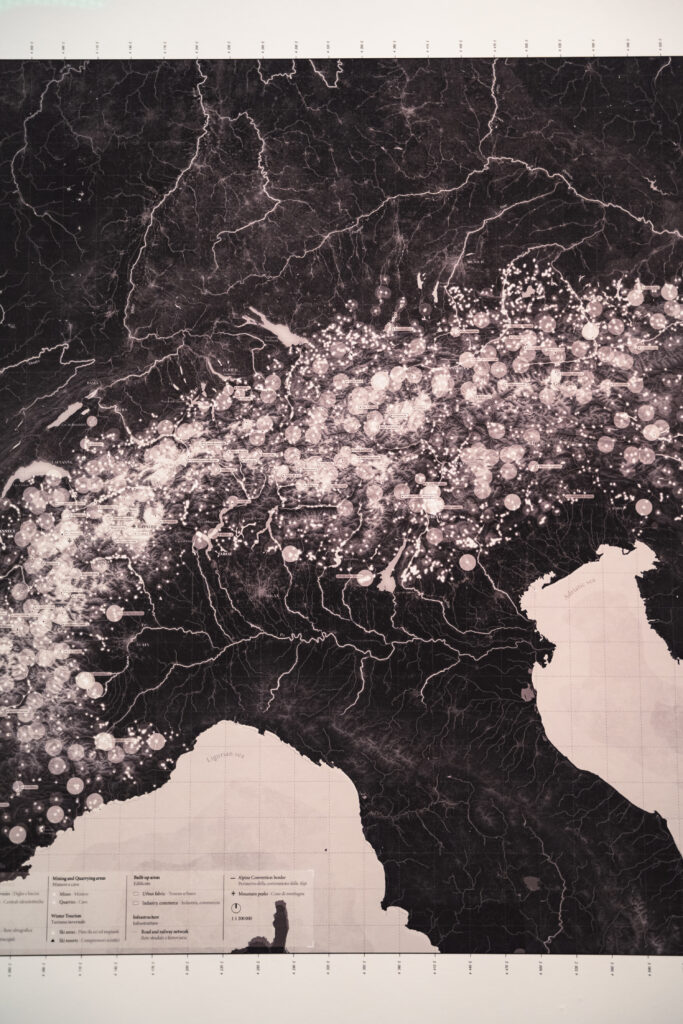
Instability is not an anomaly to be corrected, but a constitutive condition of Alpine territories. Avalanches, erosion, flooding, sedimentation, migration, and ecological succession are not failures of management, but they are expressions of ongoing material processes through which the territory is continuously produced.
From this perspective, landscape and, in consequence, landscape architecture and design cannot be understood as an external intervention acting upon a passive ground. Instead, it operates within a field of dynamic relationships among climate, terrain, water, infrastructures, economies, and more-than-human life. The task is not to stabilise territory indefinitely, but to engage with its capacity to shift, absorb, and transform.
This reframing directly challenges extractive planning paradigms. Rather than asking how much infrastructure or development a territory can accommodate, it asks where pressure must be reduced, where cycles must be slowed, and where space must be given back to movement, regeneration, or inaccessibility. Fragility, in this sense, is not a deficit but a form of intelligence and a signal of thresholds and limits.
Landscape architecture in the Alps cannot be reduced to a purely intentional or representational act. It emerges from and feeds back into the material intelligence of the territory. Every intervention, from a footpath to a mobility corridor, participates in broader systems of water flow, sediment movement, soil formation, and multispecies habitation.
Design begins not with form but with reading: microclimates, slopes, soil structures, hydrological dynamics, and existing ecological assemblages. Humans and non-humans are not separate occupants of space but co-producers of territorial conditions. Design, therefore, needs to act as a mediator within these networks, redistributing forces rather than overriding them.
Interventions become productive when they reinforce existing processes rather than suppress them. Drainage systems can operate as wetlands, retaining structures can host microhabitats, and vegetated slopes can stabilise soils while enabling ecological connectivity. Every contour, planting strategy, and material choice influences how energy, water, and matter circulate and, consequently, how the territory retains, releases, and regenerates.
The use of adaptable structures and local materials is not a nostalgic return to tradition, but a strategic alignment with territorial processes. Stone, timber, and endemic vegetation respond to temperature fluctuation, precipitation variability, and seasonal use patterns. They weather, decay, and transform alongside the landscape. Meadows, rain gardens, and alpine wetlands modulate microclimates and hydrological extremes while remaining legible and accessible as shared spaces.
One of the most persistent legacies of extractive land use in alpine territories is object-based thinking: treating buildings, infrastructure, and attractions as isolated solutions rather than as relational interventions. Ski lifts, reservoirs, roads, and hotels are frequently designed as discrete entities, detached from the wider territorial processes they reorganize.
Even projects framed as sustainable can become extractive if they fail to engage with broader ecological, social, and temporal networks. A regenerative approach requires a shift from objects to relations, or to frame it differently: from discrete artefacts to systems of interaction.
This implies a different design responsibility. Designers do not impose form onto the Alps, they intervene within complex assemblages of forces, knowing that each gesture alters existing relations. Small-scale actions matter precisely because they reverberate across systems. A restored footpath can reconnect habitats and support slow forms of tourism. A carefully placed bench can recalibrate how a landscape is perceived and inhabited. Reclaiming a gravel pit as a lake can reorient an extractive scar toward collective ecological and social value.
The assumption of continuous expansion, of infrastructure, tourism capacity, and built volume, has reached its limits in Alpine territories. The most relevant architectural and landscape practices today are not oriented toward growth, but toward repair, adaptation, and regeneration.
Regeneration does not mean returning to a pre-industrial state. It instead means recognising existing forms of life and working to support their continued viability. Seasonal and flexible uses align with the rhythms of snow cover, water cycles, vegetation growth, and labour migration. They allow territories to pause, recover, and reconfigure rather than remain permanently activated.
Some spaces are shaped primarily by rivers or forests. Acknowledging this does not imply withdrawal but rather strategic accommodation. By giving space to these processes, planning shifts from defensive control toward coexistence. Consequently, risk and hazard management also becomes less about fortification and more about retreat, buffering, and transformation.
A new, thoughtful design paradigm is essential.
The Alps demand humility. Their scale and interdependence expose the limits of control-based planning. Designing within Alpine territories means accepting uncertainty and working within a living system rather than attempting to dominate it.
Three interrelated orientations are essential. Design should be informed by ecological knowledge across scales. Reaching from soil microbiology to watershed dynamics. Performance is measured not by visual impact or efficiency alone, but by a project’s capacity to support water regulation, biodiversity connectivity, and long-term adaptability.
The approach needs to change. Local communities are not obstacles to territorial transformation but carriers of situated knowledge. Cooperative governance models, stewardship practices, and shared infrastructures align economic activity with long-term territorial health and interrupt extractive tourism logics.
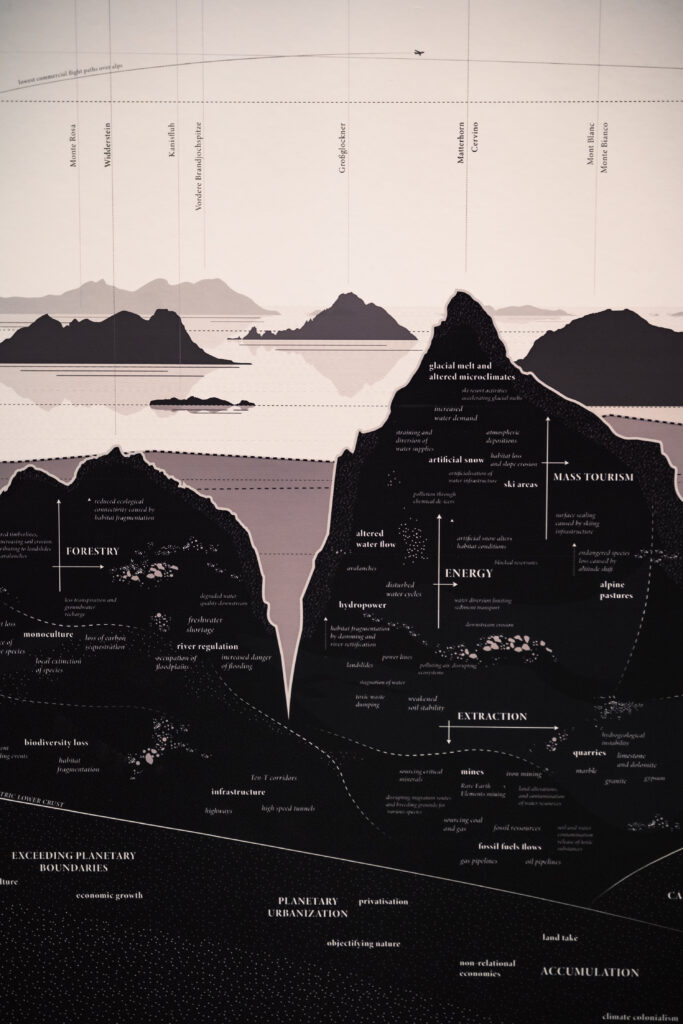
Finally, projects must be capable of changing, ageing, and even disappearing. Adapting. Reversibility becomes a core design principle. Structures that can be dismantled, landscapes that can evolve, and programs that can shift over time allow territories to respond to instability without locking them into irreversible futures.
In substance, planning should be systematic-without proposing a singular solution, but rather a change in orientation: from extraction to care, from stabilization to adaptation, from consumption to coexistence. Landscape architecture is positioned not as surface treatment or mitigation, but as a critical practice capable of reconfiguring territorial relations.
If instability is understood as a shared condition rather than a threat, new forms of planning and design become possible- forms that protect, regenerate, and sustain life in its multiple expressions. In this sense, the Alps may once again function as a learning landscape not as an idealised nature opposed to culture, but as a complex territory that teaches how to live within limits, interrupt extractive processes, and cultivate more durable modes of coexistence.