AP5 |
CRAFTING CREATIVITY THROUGHT CONSTRAINTS. ningyuan HU
reflecting on the past twenty-five years of your life, how do you now see the relationship between careful long-term planning and the potential for ongoing renewal? What changed in your thinking when you chose to dedicate our time to exploration ?
Careful planning is still there as it provides a process for thinking through something, from idea to production/action. It is still important to me to be focussed and not spread myself too thin whether it is about doing projects or traveling or cooking or hobbies. Or conversations. What has changed for me is long-term vs short-term planning which at this late stage of my life, the long-term planning is a one-off and I prefer to do short-term planning. Long-term planning is important e.g. end-of-life decisions but that gets done and is fussed over. I would rather spend time thinking about what to do in next six months, next year. That’s a change for me as when I started Exactly, I set a goal for 30 projects over ten years, which should end 2027. Beyond that I have things I’d like to do but no long-term plans.
you have spent years creating environments that encourage people to pause and truly observe. based on that experience, what are the essential elements someone should include if they want those later years to feel like growth rather than retreat?
Well, I think the important thing is knowing what you like to do and being prepared to do it. To keep these activities going for a long stretch, you have to figure out what will help you maintain momentum. That really means knowing clearly what you want to do and what you’re willing to put into it—not money, but time, thought, energy, all of that.
The first thing I did was sit down and clarify the mission and vision. If this was going to be something lasting, maybe thirty projects or more, I needed guiding principles. I had to make some firm decisions: it would not be for profit, it would stay private, it would be limited to Singapore, not spread everywhere, and it would focus on social and political issues—especially the social ones here that are hard to talk about and take a long time to unpack properly.
Once that was clear, I was ready to invest personally. I put my own home forward as the venue. I’d learned that from reading Chinese history—when a scholar fell out of favour with the emperor, exile was often the best outcome; execution was the alternative. In exile, these scholars would gather in someone’s garden, share wine and food, and talk freely about current affairs, poetry, calligraphy, art. I thought about doing something with poetry, but honestly, nobody would come. So I decided images were what interested me as the starting point. Photography, especially now, is very democratic, very unintimidating. Everybody has a phone, everybody thinks they’re a photographer these days. It lowers the barrier.
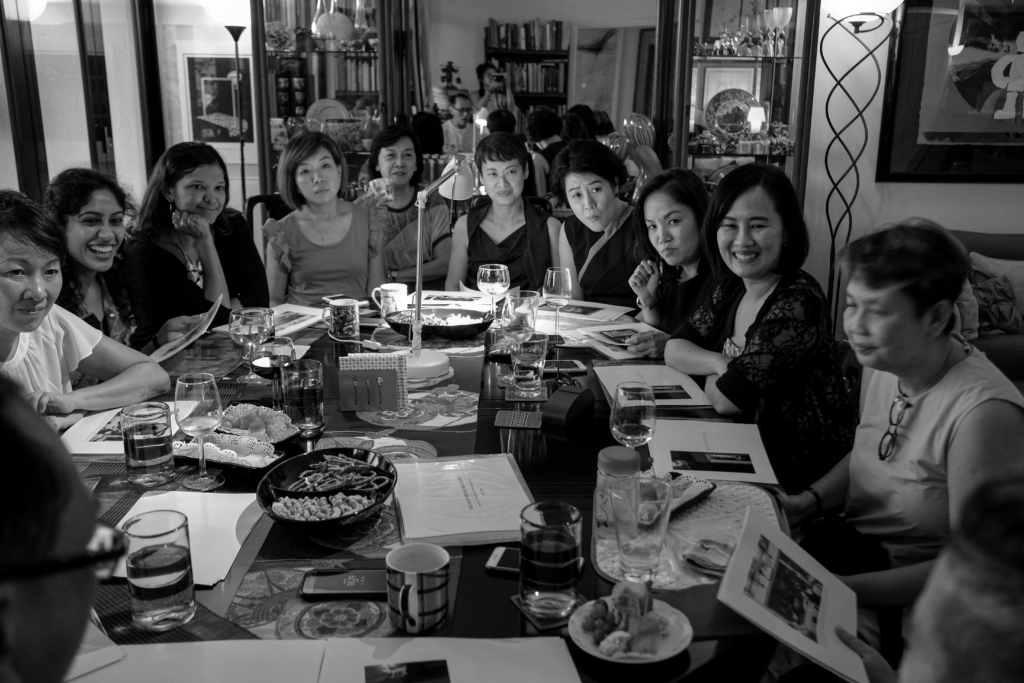
So the format became simple and inviting: fifteen people only—I had to limit it—fifteen images, one photographer, one issue. We sit around my table. But you invest real time, because it’s about six hours in my apartment. We start at four o’clock with tea and the presentation, take a little pause, then have dinner together, and it goes until ten. That long, slow stretch is what allows people to truly pause, observe, and open up. That’s how these later years feel like continued growth for me, not retreat.
how has your understanding of daily and yearly rhythms evolved since you moved from externally imposed schedules to rhythms you designed yourself? Which rituals—however small—have proved most powerful in keeping curiosity and energy alive?
I kind of let events plan me. So if a tour comes up, I go on tour. If there’s a seminar or symposium, okay, that’s what I do. If people come to visit, or there are lunches I need to have with new people, or I have to meet a photographer—that’s how it goes. Every day is different.
so, do you try to have an engagement every day?
Okay, that’s a good question. Because I need a day of rest. Usually Monday, I do absolutely nothing. And Tuesday—like today—the reason we’re meeting at Parkway Parade is this is my shopping day. This is my NTUC day. So after we’re done, I go food shopping for the week, then I go home and cook this lunch. But I also have a helper, so she’ll get things ready. It’s just the two of us, so we always have leftovers. And then I’m looking forward to a big nap.
when you wake up from the nap, what do you do?
Covid made me come up with a new hobby. I love colouring. So I sit in my kitchen and I colour. It’s called adult colouring. I love colouring kimonos. I’m on my fourth book of colouring kimonos—the Japanese books. The Japanese colouring books are very good, you know why? Because they usually have a sample already coloured on one side, and then it has the poem and the explanation. So I read that, I look at that, and then over here is the blank one. And I spend time colouring it. I use pencil colours that become like watercolour—stunning.
you have repeatedly stepped into completely new disciplines later in life. what have those leaps taught you about the kind of preparation that makes genuine learning possible at any age?
I think I just kept going to things and meeting people. Because when you go out, you socialise, you engage—you pick up new ideas from others. You’d be amazed what you learn just from listening to a lecture or having a proper conversation.
And the main thing is leaving yourself enough room to change. I never thought I would get so interested in photography. I’m not a photographer at all—in fact, I tried taking lessons once and didn’t like it at all. But I admire the medium, and I love speaking to photographers. That was a complete surprise to me.
It happened the same way with art history. I started with Indian contemporary art and classical Indian art history. Then, because the Mughals were in India for so long, I moved to Islamic art. And suddenly it went Persian, Byzantine—it kept going west and west. I remember thinking, listen, if I don’t get a grip on this, I’ll be in Rome very soon.
But you realise how it works—it’s like skipping stones across a lake. One stone to another to another, and suddenly you look up and say, wow, this is really interesting. I was very happy that I was changing without making big, heavy decisions. For example, at first I thought I was going to open a gallery. I’m so glad I didn’t go and rent a space, put down money, commit to all that. Later I thought I might become a curator—thank God I didn’t apply anywhere until I got to know the museums better.
So the preparation, really, is staying open, staying curious, going out and talking to people, and not locking yourself in too early. That’s what keeps real learning possible, no matter how old you are.
in a way there are two components, right? One that you keep to meet people and the other that before doing something you withdraw. gather and rationalize. a cycle and you don’t do it in a very reactive way. For example: you wanted to be a gallerist, but you took a step back and consider your idea.
You know, when you leave corporate life, suddenly there’s no action anymore. The big risk is that you rush into something just because you miss the action.
So you have time to sit there and just say, well, let me wait till tomorrow.
I think waiting is one of the toughest skills a person can have—because everybody, everything, demands that you take action right away.
from the spaces you have chosen or shaped for yourself and others, what have you learned about the physical conditions that fuel the desire to start new projects instead of winding down?
First, for the Exactly gatherings, people aren’t really talking to me—they’re talking amongst themselves. So I try to create an environment that makes that easy. The setup is important. It’s in the home, a private home. My dining table is very big, so I can seat all 15 or 17 people, and with two extension tables it becomes one big round thing. Everybody can see everybody, it’s comfortable, the light is good, there are interesting snacks.
And then the photographer is actually very important. I don’t choose photographers who cannot talk. The photographer has to lead the discussion. It’s not me leading—I just facilitate, you know, and of course I curate the people.
Again, it’s 15 people, but not 15 people of the same kind. Five artists or art people, five non-art people, and then five what I call residents—meaning if the topic is, say, caregiving of the elderly, these five are caregivers, or elderly themselves, or they participated in the project. So it’s 5-5-5.
The idea is not to have like-minded people. The idea is to have a conversation that has no end, no solution. I’m not organising anything with an output. And can you imagine that in a corporate setting?
A corporate person like me—people ask, so what’s your impact? I say, I don’t know, and actually I don’t care. What’s your output? Well, eventually there’s an exhibit, there’s a catalogue. But really, what’s your output? Doesn’t matter.
This is contemporary art—it’s a very experiential thing. You get together, and I tell everybody, I want you to remember this dinner. And I cook the dinner according to the theme.
okay, so how do you choose your menu?
For example, when the topic was masculinity, I served bangers and mash—proper sausages, the best mashed potatoes from a French recipe book. Then mom’s apple pie with homemade ice cream. There was a salad, and for the tea-time snack, hot dogs. Everything tied to the theme, so the food itself becomes part of the conversation you remember.
How do I get people’s taste buds to remember an event.
recalling familiarity.
Which is memory—I think it’s very well known that your taste buds can remind you of your grandmother’s cooking or some experience. But how do you get your taste buds to also tell you that you’re really angry about something?
how do you do that?
it’s the same thing—another version of memory. If you give my mother porridge with sweet potato—which in a Taiwanese restaurant today you pay extra for—she would look at it and get really upset. Because that reminds her of World War II, when there wasn’t enough rice, so you supplemented with potatoes. Today it’s considered a special porridge, but to her it’s poverty, it’s danger.
So that’s the kind of thinking I’m going for. Like, okay, if I give you bangers and mash, and you’re putting this hot dog in your mouth, what are you thinking? Right.
And so I tell everybody at the start of every dinner: my hope with this food is that you remember this dinner. And not only the dinner—you remember the conversation, you remember the issue. And then please, go out and buy a print from this photographer, put it in your house. Every time you walk past that photograph, you think: I remember that dinner. We talked about this. This is a really important issue in Singapore. We need to think about masculinity in Singapore—what are we teaching our boys, what are we teaching our girls, and so on.
over time your own criteria seem to have shifted toward depth, transmission, and shared insight. How did it happen?
Good question. I’ve got to admit I’m still very much driven by numbers. Right, of course. I tell everybody exactly is 30 projects—I’m on 25 now. And that seems like, oh God, such a big number, and I’m so proud of it. But I have to tell myself, and tell everybody, that by 2027 the 30 will be finished.
There will be 29 catalogues, I guess about 15 exhibitions—usually it’s two projects to one exhibit. And that’s it. So it’s still very numbers-oriented.
But numbers are one way. The other thing is harder to say as an output—what I’ve learned through doing these 30 projects. I’m so grateful for that. There are so many people I wouldn’t have met otherwise. There would have been no reason for us to meet.
so for somebody who wants to start a new activity, can you give some sort of ideas to plan , or a road map for the direction of the venture?
First you decide whether or not you even want a measurement. I don’t think the 30 I’m talking about is necessarily a measurement.
There is a process in every project, and that process is more or less the same from beginning to end. I do follow it. That’s not so much a measurement—it’s milestones.
For example, there’s a starting point for the project. Within about two months the photographer should be ready to present. Then there’s one dinner and one photographer-sharing session—so two engagement sessions. Two months after that everybody comes back together to share their responses. And six months after that is usually when there’s an exhibition. When the exhibition happens, I also launch the catalogue, which has the portfolio and the responses. So it’s a two-part thing.
That clear timeline keeps everything moving, but the real value comes in the connections and the depth along the way.
you have seen how a tiny circle—sometimes no more than twelve or fifteen people—can create a lasting sense of community without any ‘institutional’ weight. how were you able to foster community and discuss big problems without being institutional or trying to be institutional?
I don’t know if an actual community is created—or has emerged from these projects. It feels more like clusters of thoughts. And whether there’s real thought leadership coming out of it remains to be seen, because some of the people are already thought leaders in their fields.
For example, as I mentioned, out of the 15, there could be five who are residents. They’re already working on the issue, so for them this is just an extra layer—like, you can actually use photography to communicate this. They might take that idea and run with it, and I’m happy with that.
Because these projects don’t have that kind of ending.
would you say that you keep in contact with workshop participants? you see them regularly? and do they meet among themselves?
Some, yes. I keep in touch with some people, but not others. And some of them keep in touch with each other on their own.
They might meet—I don’t know. It’s a spontaneous thing. Sometimes they already knew each other before.
It’s like throwing a pebble into a pond. You see all these ripples spreading out. But are you going to measure the ripples? Are you going to check how big each one is, or whether one ripple crossed over another? That’s the difference between corporate and non-corporate.
Stop measuring—that’s a nice way to put it. Just let the ripples happen.
it’s interesting: ripples, interest-driven development. sometimes urban environments make it hard for people to find new things and new people. i was speaking with a friend about the feel of ‘shenzhen’ for example. Singapore is a bit similar: significant city re-qualification and rebuilding. things happen in pockets. meeting and doing is almost the result of a plan, do you think?
Yes, it’s sort of about planning and choosing. I think that, if you look hard enough, there are many speeds in Singapore. The good thing is that Singapore is very walkable. You walk everywhere. And as you walk, you go into void decks, hawker centers, markets, and all that. In some places, the speed is very high, but I’m always amazed at hawker centers where people come out at 10:30am and start drinking beer, you know. So there’s a speed there that’s very different.
speed in terms of pace, and then speed and tracks in terms of different social environments. One day you are here, but tomorrow you can decide to be somewhere else and deal with a different reality, avoiding people you don’t really relate to and moving on a different track. do you think Singapore is helping you do that? so, in picking your speed, were you also able to pick your own people who were of a different speed?
I can only live in an urban environment. It’s precisely that which allows me to walk in urban settings, stop to get a drink or go shopping at a little shop, meet somebody new, or go to a mall. Everything is very accessible.
And that has been so important to me because I’ve been able to set my own pace; it goes back to the original idea of engaging broadly. I can choose how I want to spend my time.
what will be your next thing?
My next thing—I’m getting very interested in lesser known cuisines, those that have always lived in the shadow of their more famous neighbors. The cooking/eating and marketing techniques that are being pushed aside because another a mega cuisine nearby had become a global star.
I have decided to focus on researching Cambodian food – vis a vis Thai/Vietnames food – and Hokkaido’s Ainu food – vis a vis Japanese food.
And as always, I’ll go straight for the courses and the academic side of things. Having a proper lecturer is really important to me. I can’t just go and eat and look—I need someone to explain the history, the migration, the adaptation, why certain flavors stayed and others disappeared. That’s why, whenever I choose a tour, if there’s a lecturer on the trip, I’m much more inclined to book it. I don’t want the “look-see, and eat” kind. I can’t keep going to cooking classes —I really need the lecture part.
But I also want the popular side, the social side—what people actually eat outside, at home, with friends. The everyday food that carries the real story.
I just bought this book—it’s small, Cost $75, I still can’t believe it—called The Indigenization and Hybridization of Food Cultures in Singapore. Actually, it’s more about the indigenization of food through ceramics. It looks at the plates, the vessels that hold hawker food, altar offerings, home-cooked meals—how the objects themselves tell the story of how food became local here.
Let’s see where this new interest takes me.