ARMANDO PORCARI. FABRIZIO DEL SIGNORE.
founders & owners. The Gallery Apart. ROME.
tiered engagement. and a crisis of meaning.
the twenty-two years of the gallery apart — what were the conditions when you opened? how did the contemporary art gallery sector look in italy and internationally when you began, and how did this shape your choices about programming, about artists, and about the kind of gallery you wanted to build?
In the early 2000s we should have found ourselves in the most extravagantly futuristic scenario imaginable. Instead, the Roman art scene was anything but sparkling.
When we started to consider a more direct engagement with the artists we frequently encountered, we noted that many talented individuals living and working in Rome struggled to gain visibility. The skill of self-promotion was particularly challenging since, at that time, artists were not yet fully familiar with the internet—the World Wide Web had only just appeared around 199-), there were no cheap flights, artist residencies were still rare, and art fairs were few. As a result, actively promoting oneself to reach the market was genuinely difficult.
Rome was also living through one of its recurring periods of stagnation, and emerging Roman artists were almost all trapped in a shadow.
This situation compelled us to act decisively, not only as collectors but also by providing a home for artists we highly admire. Our prior professional commitments led us to embrace a nomadic lifestyle. In 2003, when the Trussardi Foundation in Milan—an institution with significantly greater resources—chose a similar path by actively searching for ideal locations within the city, we also decided to host the projects submitted by artists to us in Rome.
We established two rules: first, to fulfil the role of a commercial gallery, and second, to fully engage the host institutions, which never requested us to pay a fee. We viewed this as a way to maintain the integrity of our projects and prevent any potential misunderstandings about our role.
Convincing those familiar with us that we were not engaged in patronage and that we aimed to be a fully recognized commercial gallery was challenging. Giancarlo Politi was the first to see our initiative beyond the city limits and suggested a brief interview in Flash Art, which greatly helped ensure our message was understood correctly. Eventually, the fair organizations were the last to recognize us; they rejected our applications because our gallery lacked a physical address.
Out of responsibility to our artists, who deserved the spotlight at fairs, we concluded our nomadic journey. We began with a small space in via della Barchetta, which was relocated to via di Monserrato less than a year later. In 2013, we moved to larger premises in via Francesco Negri, which served as our location until the gallery closed in June 2025.
how did the relationships with the artists you supported across twenty-two years? what did it mean in practice to support young artists in their research — the gallery’s declared mission? where did you invest your efforts, your attention, your resources? specific stories of artists whose work was supported by the gallery would be particularly valuable.
The first artists with whom we collaborated were a direct extension of an already established friendship, and they served as the first point of contact between two people who wanted to share the gallery experience but came from very different collecting practices. Gea Casolaro, Myriam Laplante, Fabrizio Passarella, and Andrea Aquilanti were artists we both love who had the courage to embrace our project.
We eagerly pursued discovering new talents by working with very young artists, initially selected locally, then across Italy, and ultimately throughout Europe. Nearly all collaborations were built on shared choices, honesty, and genuine connection—elements that strengthened our bonds with the artists. This spirit became especially clear at the closure of projects, as every artist showed us genuine affection and friendship.
Initially, the focus was on offering material support by organizing exhibitions and taking part in major Italian fairs. Over time, increasing awareness and conviction helped establish the gallery’s unique identity. As our intellectual and practical engagement with our artists’ practices deepened, we developed a more refined sensibility and greater Respect for their work. This guided our careful and attentive approach to curating exhibitions within the gallery and designing fair stands, which we always crafted as cohesive and unified presentations.
The encounter with socially and politically engaged artists shaped the final years of the gallery’s history. It was a deliberate turn — a choice to engage artists who shared a common cultural feeling, who wanted to use their work to take a position. The exhibition Subterfuge, curated by Mike Watson, opened a fruitful relationship with internationally recognized artists such as Oliver Ressler and the collective Chto Delat, with whom we had our say in a moment marked by strong xenophobic resurgences. Come in quickly, otherwise I’m afraid of my happiness! Xenia at the time of war, which Chto Delat shared with Babi Badalov, was a true hymn to welcome precisely as the Italian Government of the time was closing ports and turning away asylum seekers. Throughout, the taste for discovery remained: as at the start of the adventure we had laid foundations for then-newcomers like Alessandro Scarabello, Mariana Ferratto, and Luana Perilli, in the final stretch we also launched very young artists like Sinae Yoo and Federica Di Pietrantonio.
a gallery does not operate in isolation. it works through a wider fabric of collectors, critics, journalists, museum curators, institutional partners, fair organisers, other gallerists, foundations. how did you build and maintain those connections? which were essential to the work? how did the gallery exist within that wider ecosystem, and how did the ecosystem change across its twenty-two years?
We learned early that working with the other figures in the system — collectors, critics, museum curators, fair directors, fellow gallerists, foundations — was both an aspiration and a necessity. Our prior connections from a long collecting history opened the first doors; what kept those doors open was an active commitment to fostering a generous climate among the people closest to us. Community is built, not inherited.
In Rome we worked from this principle deliberately. In 2010 we proposed Roma art2nights, a weekend of gallery openings — including evening hours — with international collectors invited and hosted by the galleries themselves. The idea was that a city’s galleries are stronger collectively than competitively. That first step led to Contemporanea, now in its fourth edition. The same instinct moved us to host Matteo Nasini’s exhibition in our space when it was in fact a project of Ermes Ermes, another Roman gallery then starting out with the nomadic model we had used at our own beginning. Hosting them seemed obvious; it was the climate we had wanted to be hosted into when we were starting.
The wider ecosystem we worked within changed epochally across those twenty-two years. The opening came in 1989, with Magiciens de la terre, curated by Jean-Hubert Martin at the Centre Pompidou. That exhibition’s recognition of artistic practices from all continents coincided with the rise of turbo-capitalism after the fall of the Berlin Wall, and the consequence was an exponential expansion of artists, fairs, biennials, and gallery sites. Within a few years, a different geometry had emerged: a small number of galleries opened many sites worldwide, each representing dozens of artists who became the dominant figures of the international scene. The middle tier — medium-sized galleries doing serious work at moderate scale — was the part of the ecosystem that suffered most. The many closures of recent years are the evidence. The market concentration in the hands of a few intertwined with two further developments of revolutionary consequence: the entry of the large auction houses into the primary market, and an unprecedented surge in Biennials and fairs.
Keeping pace with these shifts was challenging. What kept us going was that, throughout these transformations, figures guided only by the search for quality continued their work, and their support and recognition were the constant we could count on. That, in the end, is how a gallery exists within an ecosystem: not by being part of the dominant geometry, but by recognizing — and being recognized by — the figures who hold quality as the only currency that matters.
the relationship between gallery and collector is a particular kind of engagement. what did you learn about that relationship across two decades? what did the good collectors do for the artists and for the gallery? how did the collector base change across time, and what did those changes signal?
We both come from a background of collecting and belong to a generation that succeeded the one in Italy at the time, which favored remaining anonymous. The divide between the collector who purchases solely to satisfy an intellectual curiosity and seek spiritual pleasure, and the one who now only buys works that look good in photos for social media sharing, illustrates how collecting has evolved in recent decades.
Perhaps witnessing this moment inspired us to focus on new collecting practices. The enthusiasm and passion of newcomers often rekindled in us a sense of the fundamental connection with the work, contrasting sharply with the pathological drives behind the financialization of art.
The relationship between gallery and collector has certainly changed radically. Once, when even the most important galleries had a single location and the opportunities to expand their contact base were few, each gallery had its own user base of collectors who followed the gallerist’s path.
Today, anyone can find the object of their desire anywhere on the internet, and the era of exclusive relationships has ended. In response, many research-focused galleries have started including artists at the end of their careers, focusing on the secondary market, or following current trends. There’s no blame in this—galleries are businesses and naturally pursue strategies that work. We never aimed to do this. We have featured established artists like Cesare Pietroiusti and Gabriele Di Matteo, but only because their work aligns with the gallery’s editorial vision.
public institutions, foundations, museums and fairs had a role in the gallery’s work. how did those partnerships function? what did they ask from you as a gallerist, and what did they make possible?
Institutional partnerships are rarely partnerships with institutions. They are partnerships with the individuals who occupy them — directors, curators, board members, programme heads, the producers and patrons who hold authority within larger frames.
Across twenty-two years, our approach was to make our professionalism fully available to these figures, to put forward proposals of quality, and to show ourselves as reliable partners in the realization phase. The institutions did not patronize us. They responded to what we brought, and the relationship was sustained by mutual recognition rather than by formal arrangement.
A long list would not capture it. We will limit ourselves to a few figures who illustrate how this worked. Hou Hanru, when he was Director of MAXXI Arte, always kept a watchful eye on what we were proposing. Beatrice Merz, an excellent hostess on the occasion of the third edition of the Premio Merz, helped launch Bertille Bak into the firmament of international art. Beatrice Bulgari, through her In Between Art Film, helped us greatly in spreading awareness of artists like Oliver Ressler and Bertille Bak. The staff of Artissima — the directors who succeeded one another and the load-bearing pillars who remained the same throughout — gave us great attention, which we received as the response to the commitment we always poured into proposing curated and never banal stands.
The same principle held from the beginning. We could count, in our first years, on the support of extraordinary individuals. Cecilia Casorati, then a teacher at the Accademia di Belle Arti di Roma, pointed out to us a particularly fortunate cohort of recent graduates from whom we drew the collaborations of our first discoveries, and offered us hospitality at her 26cc where we exhibited Florian Neufeldt for the first time. Flavio Misciattelli shared our projects three times at the Fondazione Pastificio Cerere. Franco Nucci hosted us at Volume! for Myriam Laplante’s Elisir, which fifteen years later was selected and re-staged as the best exhibition realized in Rome in the 2000s within Mostre in mostra at the Palazzo delle Esposizioni — a project curated by Daniela Lancioni in which six exhibitions were re-proposed for each of the decades from the 1950s to the 2000s.
Ultimately, what sustains a gallery within an institutional ecosystem is not just access to institutions, but the trust of individuals who appreciate quality and choose to support it. This trust is not a one-time gift; it must be reaffirmed with each project that demonstrates it. Institutions serve as the framework, but the true connections are between people.
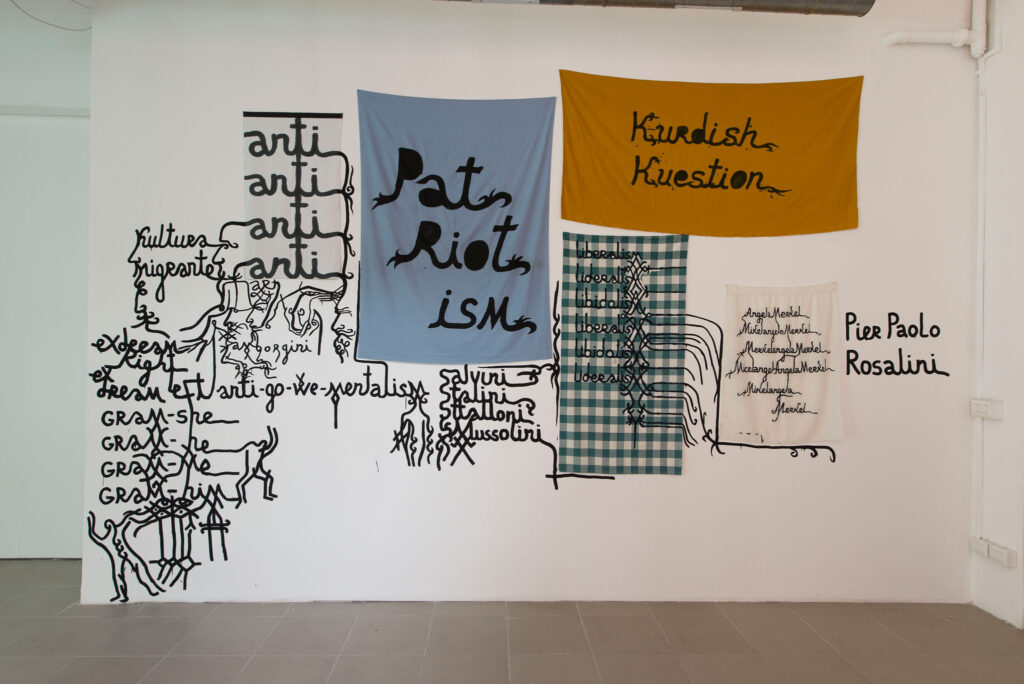
Babi Badalov, Xenia at the time of war. 2018.
the closure message shared by you and fabrizio del signore referred to the “crisis that is shaking the entire art sector”. how did this crisis manifest itself from inside the gallery in the months and years before the decision? what changed concretely — in collectors, in attention, in market dynamics, in operating costs, in the institutional and fair landscape? when did you begin to understand that the gallery could no longer continue, and what pushed you to carry on beyond that moment?
There are crises that a gallery – i suppose like any other business – can survive, and there are crises that change what a gallery is for. In light of the many changes that occurred across over twenty-two years, we have come to recognize this distinction with some precision.
The crisis that led us to close only partially affected our approach to business or how our offerings were perceived. The hundreds of messages we received afterward confirm this — the most common feedback was about the loss of a point of reference in the Roman, and possibly national, art scene. We will be forever grateful for these expressions of support.
We’ve experienced other critical moments before. In 2008 and 2012, the challenges seemed evident, but they were clearly liquidity crises and temporary uncertainty—things to navigate. Today, the nature of the crisis is different. It’s global, affecting relations between nations and individuals, highlighting vast disparities not just between the global North and South but also within the wealthiest societies. There’s a loss of historical memory and a rise in ignorance that’s unafraid to show itself. This isn’t merely a crisis of circumstances; it’s a crisis of meaning. The art world can’t simply wait it out by tightening operations or hoping the cycle changes.
Initially, it was the small collectors—those who looked to art for intellectual renewal—who were the first to be frightened, as they suddenly confronted doubt, the initial step toward losing meaning. We noticed this when visitor numbers at our exhibitions sharply declined. Our exhibitions, especially popular among young people and students, had been a source of pride. When peers also reported similar drops in attendance, we realized we faced a fundamental loss of interest—a sign of a broader credibility crisis in the contemporary art scene and a psychological state where the cultural offerings no longer engaged or contrasted with the prevailing silence.
Looking back, we understand that a gallery can withstand nearly any material crisis because circumstances tend to cycle. However, a crisis of meaning is different; it questions whether there is still space for the kind of work we do — the careful, thoughtful, intellectually engaged effort of supporting artists over time and sharing their work with others who might be influenced by it. This isn’t solely our decision; it depends on society’s willingness to support such work and the cultural institutions’ commitment to defending that space when it is challenged. We continued as long as we believed in the importance of our work, but we closed when we could no longer be confident that this space still existed.
what did you understand after the closure about the art ecosystem, about engagement, that you could not see while you were still operating?
That art cannot be a happy island disconnected from the general context. There remains only the hope that consciences will reawaken, and that it will be understood that it is the human being who must find within themselves the seed of renewal, passing first of all through the refusal of barbarism. As a consequence, the art world will also change for the better.
your gallery worked for two decades to build the conditions for serious artistic research. that work continues in the artists themselves, in the collectors who own their works, in museum collections, in critical memory. what survives of the gallery apart, and are you still in contact with the ecosystem?
We have no desire to fade away from public view. Why would we do that just to seem like bohemian heroes? Fortunately, these years have been filled with meaningful encounters, friendships, and relationships that go beyond the typical buyer-seller dynamic.
Our collectors are individuals of substance with whom we have built relationships that extend beyond mere transactions. The same applies to many curators and institution directors. Our ongoing bond with our artists endures; we often converse, listen, and assist them where we can. Lastly, we cherish memories of those who worked with us in the gallery. Hearing that we contributed to their professional growth and that they remember us fondly is a deep source of pride.
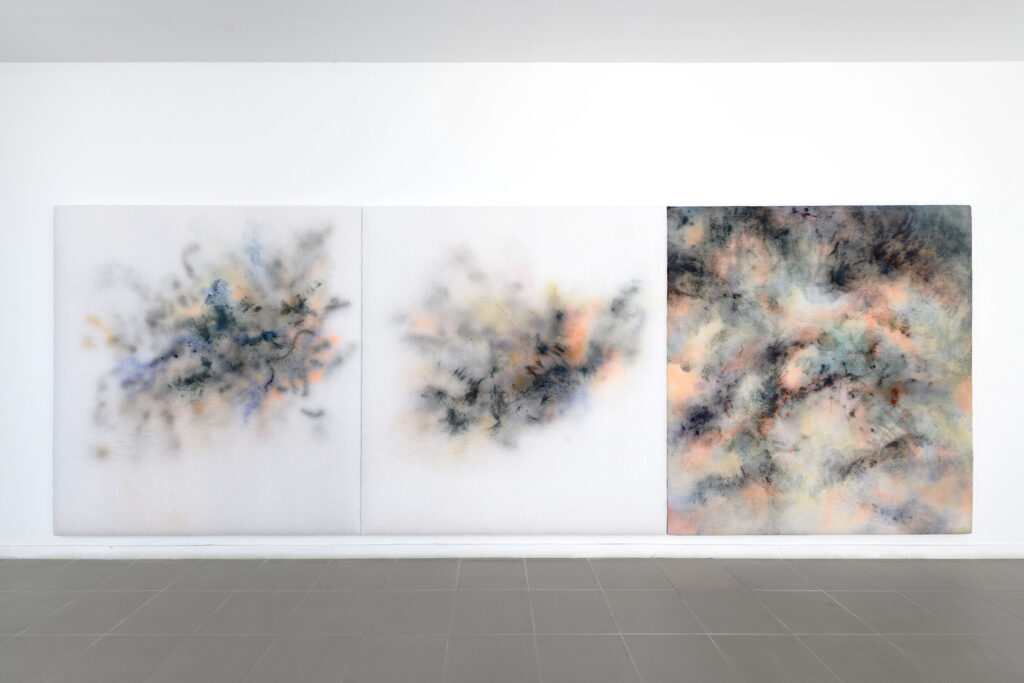
Corinna Gosmaro, Delusional Beliefs. 2023.