CARLO GIBERTINI.
researcher. writer. MODENA.
staging authenticity: can innovation save the Food World we’re building?
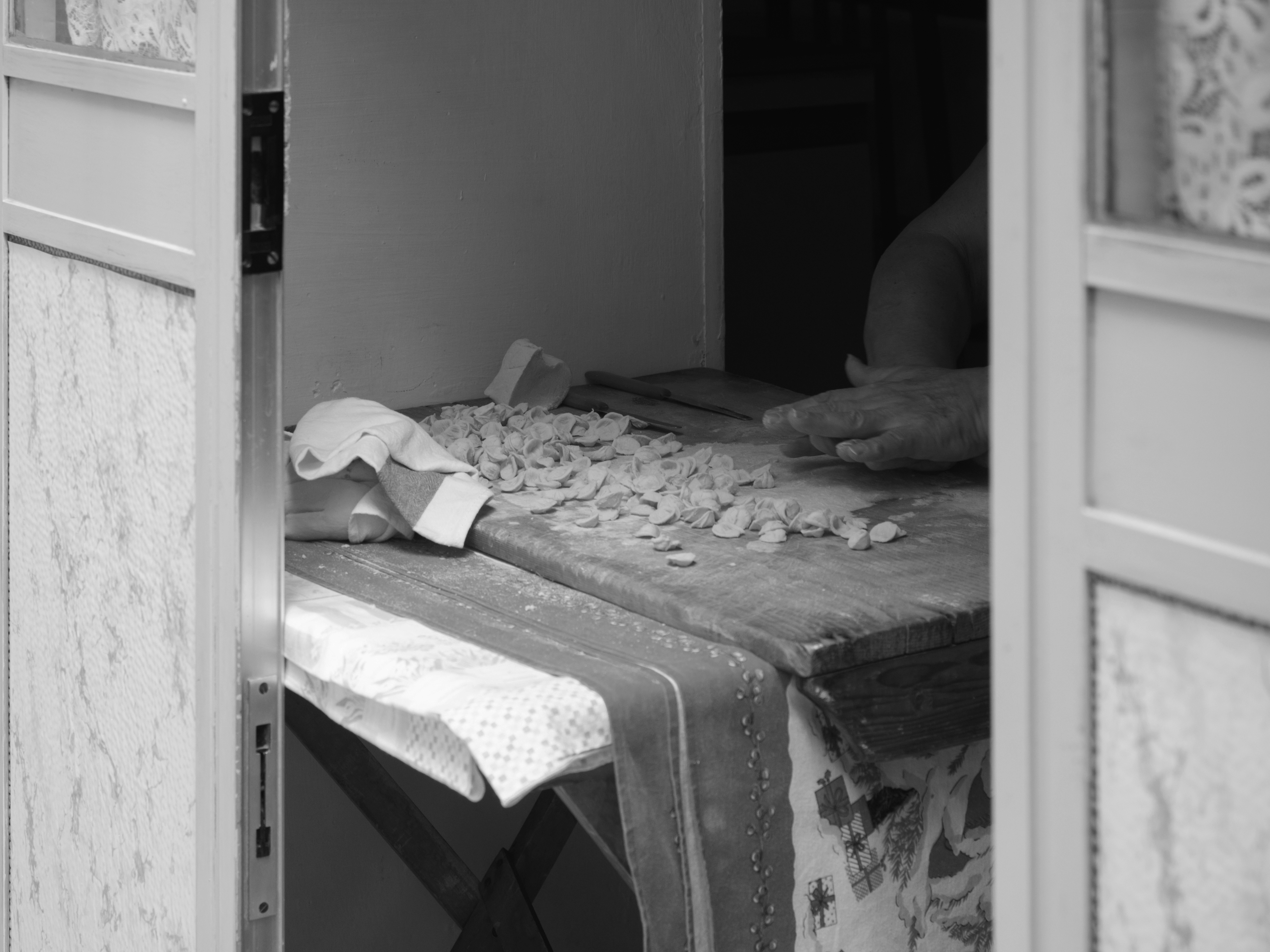
Those born and raised in Bologna may find it strange to walk down Via San Felice and spot a shop window where, instead of clothes or accessories, women are stretching dough by hand. These women are known as sfogline (sfoh-LEE-neh)—an iconic, though deeply rooted, figure in Emilia-Romagna’s food culture. For centuries, they represented a humble culinary tradition: rolling fresh pasta by hand using simple, accessible ingredients like flour and eggs. This practice helped families save money while creating a variety of dishes, from tagliatelle to tortelloni.
So why does seeing them behind glass feel uncanny? Because traditionally, sfogline didn’t perform. They weren’t part of a show designed for the tourist gaze (a concept introduced by sociologist John Urry in 1991).
Nowadays, Bologna’s booming tourism—over 5.8 million overnight stays in 2024—has turned tradition into a staged attraction. Tourists come in numbers, and they are hungry for experiences, alterity, emotions, local food, and above all: authenticity.
But what kind of world are we building in the food business today, in the name of authenticity?
Sociologist Dean MacCannell was the first to introduce the concept of “staged authenticity” in the 1970s. Inspired by Erving Goffman, he argued that tourists seek the illusion of access to a place’s “backstage,” when in fact they’re offered a curated performance, contrived productions on the ‘frontstage’—like the sfogline in the windows of Bologna’s medieval porches. This phenomenon turns locals into actors in their own city; extras in a theatrical version of their lives. Think Venice, today. The experience appears genuine, but it’s carefully designed to meet visitors’ expectations.
This performance? creates a hierarchy between those who observe and those who are observed, where the latter become part of the scenery itself. Their role is to authenticate the scene, like a human stamp of approval. It’s a form of post‑hoc cultural reconstruction: real elements are reshaped into a digestible, marketable version of tradition, repackaged to meet the tourist’s desires, and sold at a premium.
Take, for instance, the farm‑to‑table label. Once celebrated for supporting local economies and sustainable sourcing, it now often commands higher prices while veiling vague (or even false, in some cases) claims about where the food actually comes from. Investigations have uncovered restaurants billing imported or industrially produced ingredients as locally grown, a practice critics call ‘farmwashing.’ This deceptive marketing inflates consumer trust and costs, making authenticity a commodity more than a practice.
Or take the ubiquitous “nonna’s recipes” rhetoric—a feel-good marketing trope evoking warmth and comfort but usually rooted in stereotypes. As Eric Hobsbawm wrote, traditions are often invented. Professor Alberto Grandi recently exposed this issue in his internationally famous book ”Denominazione di Origine Inventata” – fictional denomination of origin – (Mondadori, 2018), revealing that many “heritage” Italian dishes are in fact constructed narratives, designed to increase commercial value.
In short, there is little authenticity in concepts crafted for spectatorship, detached from their original social and cultural context.
The reason why this is happening is pretty obvious: because we live in a visual economy. In the US only, statistics say that diners aren’t just searching Google anymore—72% of people use social media to research restaurants, and 68% check a restaurant’s social media before visiting. With rising food and labor costs, social media has become a powerful, and affordable, tool for visibility. And this applies globally, especially in tourism-driven regions.
Food marketing has fully absorbed this logic. Pop-up restaurants, for instance, are the epitome of performative aesthetics: they leverage “Instagrammable” locations—abandoned warehouses, rooftops, historic buildings—to craft “authentic” experiences that are, in reality, meticulously designed for social sharing.
Originating in the early 2000s’ underground dining scene, pop-up restaurants have reshaped the food service industry, offering entrepreneurs a way to reduce overhead and generate excitement with limited-time concepts, but on the other hand, raising questions about cultural appropriation or exploitation, especially when the pop-up is driven by profit rather than genuine cultural exchange.
In light of all this, it’s a moral duty to imagine alternative models that are much more sustainable, and honor aesthetics while remaining grounded in real practices. Ideas and projects that contribute to building a new world and do not only act as replicas of the past: because authenticity isn’t mere decor or a traditional look, but a reality lived through practice. Authenticity lives in choices:Low-intervention farming farming, waste reduction, sharing knowledge, preserving techniques and knowledge, fair compensation, affordability. Not in folklore.
To move beyond spectacle and build a more authentic food world, practicality is needed. So here’s a decalogue for restaurateurs, producers, and makers of authentic experiences:
1. Transparency – Let’s share the full provenance of ingredients and production methods. Customers deserve clarity, not curated illusions.
2. Education – Let’s teach through workshops, tasting sessions, or open kitchens. Don’t just stage authenticity: pass on the know-how.
3. Accessibility – Let’s keep prices fair, because authenticity must remain reachable: it’s about genuine craft, not exclusivity. Let’s not feed the narrative that good quality always comes with a high price.
4. Local sourcing & short value chains – Let’s partner with community-supported agriculture (e.g. GAS in Italy, gruppi di acquisto solidale) and nearby producers to strengthen regional economies and soil stewardship.
5. Seasonality respect – Let menus follow the calendar instead of tourists’ expectations. That means aligning dishes with the actual availability of vegetables, grains, and fish—unlike the fried calamari and shrimp that flood tourist menus across Southern Europe in summer, even when they’re out of season. Honoring seasonal rhythms keeps culinary traditions alive and rooted in the real.
6. Community integration – True community integration means designing experiences that connect visitors with the people, places, and practices behind what they eat. One such example is a current FAO/UN project in the Pacific Islands, aimed at creating sustainable gastronomy tourism itineraries and redefining farmers as cultural ambassadors. The project, titled “Development of Sustainable Gastronomy Tourism Itineraries and Value Chains in the Pacific SIDS”, fosters direct, hands-on engagement: cooking workshops, community gardens, and local markets offer travelers a deeper connection with local agrifood systems. Here, authenticity is not a performance but a shared experience.
7. Transnational heritage preservation – Let’s take cues from the EU‑funded Culinary Trail of the Danube, which digitally archives recipes and maps minority food traditions, ensuring authenticity is a shared inheritance.
8. Reviving traditional venues – Supporting the renewal of trattorias, tavernas, and small family-run eateries (like the neo-trattorie in Italy or the νέα ταβέρνες in Greece) can offer a powerful model for keeping culinary heritage alive. But these initiatives should never become marketing strategies in disguise: the goal is not to rebrand tradition, but to rehabilitate places dense with know-how, history, and community. Innovation should enhance only what truly needs improvement, without using it as a pretext to raise prices or distort the original spirit of the venue.
9. Staff training & pride – Let’s invest in your team; a knowledgeable staff embodies authenticity every day. It’s the only way to ensure food is practiced, not paraded.
10. Functional aesthetics – Let’s design with intent. Beautiful space is fine, but not if it’s just background for an Instagram moment. The kitchen and the story must come first.
Looking at? Following these virtuous paths, we must ask: what kind of world should we building in the food business today, in the name of authenticity? Surely a world where places are not destinations, but communities; where traditions are not commodities, but canvases. A world where customers and tourists are not passive consumers, but stakeholders in a more just, inclusive, culturally rich, and human-centered food ecosystem—one that offers real dividends to those who take part in it: some in the form of economic return, others in the form of symbolic and cultural enrichment that comes from meaningful travel and shared experience.