AP4 |
dialogues. kok wing TONG
KENRY PEH.
marketing manager, Pek Sin Choon. SINGAPORE.
how long have you lived and worked in Chinatown?
Our story in Chinatown began in the late 19th century when my great-grandfather, a tea farmer from China, shipped his teas to Nanyang (Singapore). After his passing, my great-grandmother, with sheer resilience, uprooted the family and brought us here to plant new roots. Since 1910, we’ve called Singapore home: starting on George Street, shifting to New Market Road after WWII, then to Teochew Street, and finally settling on Mosque Street in 1998. Through four generations, Chinatown has been our life, our workplace, and the keeper of our memories.
how has the Chinatown community identity evolved over your lifetime, and what key historical events shaped it?
Chinatown was once a lively mosaic of dialect groups and traditions—Hokkien, Teochew, Cantonese—each with their own festivals, foods, and stories. Then national development transformed everything. We were displaced from George Street in the 1940s after WWII to New Market Road, and by 1988 to Teo Chew Street to make way for roads like the CTE. We moved again for the MRT and shopping malls.
Today, high-rises overshadow the kampong spirit. The see-saws and trees we played around as kids are gone, replaced by a more man-made environment. Do we need more souvenir shops or cafes to tell our story? No — we need spaces that honour people, not just profit. Let visitors sit under real trees, sip tea where families once gathered, and feel the soul of Singapore.
what percentage of old-time businesses survive?
Maybe only 10 to 20% of traditional shops still operate along the street, and even fewer local hawkers or market stalls are run by locals. Many have closed due to skyrocketing rents or redevelopment. However, our tea corner—a tradition of sharing freely since 1910—remains open. After COVID, some worry about hygiene, but we keep it going for anyone needing rest or connection. Locals, tourists, and elders still stop by to pour themselves a cup. Soon, we’ll add chairs outside so even the hesitant can pause, recharge, and carry on.
are there still community-driven activities?
Yes, but they’re fragile. We host CNY dumpling-sharing with neighbours, our PSC family and staff, Mid-Autumn lantern gatherings, and even team up for a community book launch. However, as old neighbours close their shops, these events shrink—that’s heartbreaking. Still, we keep going. Even if only a few of us remain, we’ll continue to keep the kampong spirit alive.
could you share with us your business breakdown: B2C business vs your B2B?
Our wholesale business is 80%. We supply 80% of Singapore’s Bak Kut Teh chains with our signature Nanyang tea blends.
Our retail business is about 20%, split between our recently launched e-commerce and our Mosque Street shop, where everyone—locals, tourists, and weary passersby—can enjoy teas like the “Renowned Unknown Fragrance,” which was once reserved only for B2B clients.
how have you adapted your operations strategies to appeal to both locals and visitors?
Our shop now blends tradition with modernity. The tea corner features a digital QR code that links to our family’s story, and we display teas in both rustic tins and sleek gift boxes. For tourists, we explain how our teas connect to Singapore’s history; for locals, we brew nostalgia.
how has the way your staff engages with customers evolved as the clientele has shifted from local regulars to include more tourists and younger generations unfamiliar with traditional tea culture?
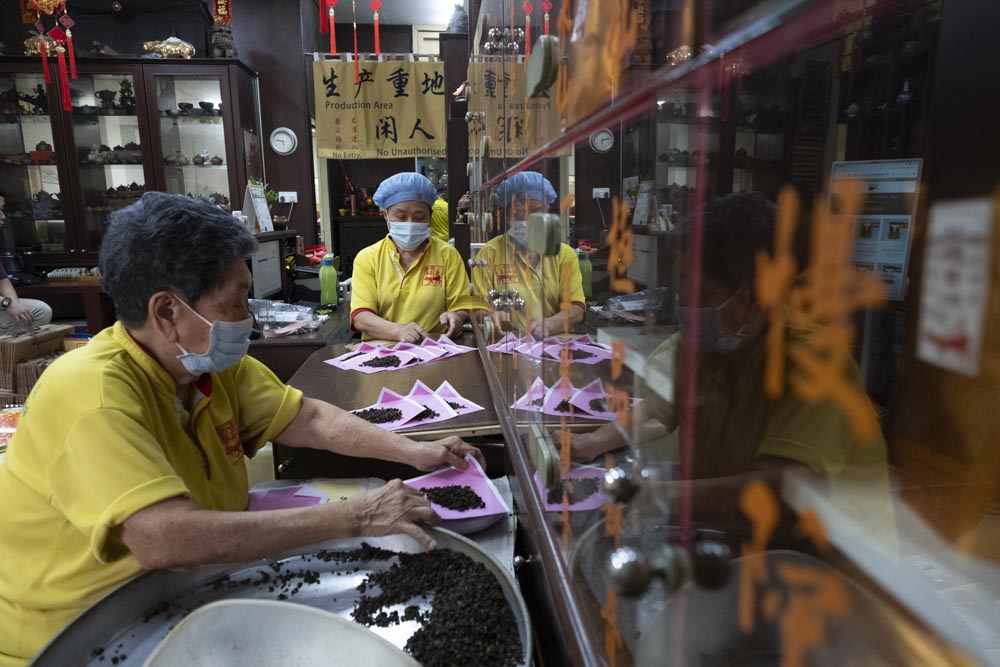
We train staff to share stories, not just sell. To a tourist: “This tea fuelled generations of bak kut teh chefs.” To a local: “Remember when kids swam in the Singapore River? This blend tastes like those sunlit days.”
how do you balance preserving the traditional practices, like hand-packing and charcoal roasting, with the need to innovate for a modern market?
We still hand-pack and hand-blend teas – it’s how we ‘listen’ to the leaves. Charcoal roasting was halted due to fire regulations, but we recreated its warmth with a custom roasting machine that mimics the smoky depth of the past. Tradition evolves, but its soul remains.
We believe that Nanyang tea culture is an integral part of Singapore’s heritage. To preserve it, we propose:
Storytelling: Share the story of Nanyang tea culture through events, workshops, and activities.
Community engagement: Engage the community in preserving and promoting Nanyang tea culture.
Heritage conservation: Preserve historic buildings and landmarks associated with Nanyang tea culture.
are you collaborating with other businesses to sustain heritage?
Yes! We partner with chefs, artists, charities, and organise food and tea pairings to help raise funds for local art, the community and young entrepreneurs to reinvent Nanyang tea culture. We infuse teas into modern desserts, hosting pop-ups, and sharing stories through art. Heritage isn’t a museum; it’s a living conversation.
as Chinatown continues to modernise, how do you plan to organise your activities? what kind of support and policies do you think are needed to sustain its legacy and grow and to maintain its authenticity?
Rent control for legacy businesses. Grants to preserve crafts like tea-blending. zoning laws to prevent ‘souvenir shops”’ or mala restaurants from displacing family trades.
what actionable initiatives or activities could attract Singaporean locals back to Chinatown and be sustained by the stakeholders of the area?
In our view several activities could be designed to attract Singaporean locals back to Chinatown.
This would include organizing community-led initiatives, encouraging local businesses, residents, and community groups to develop and promote their own events, workshops, and activities. Heritage preservation: Preserve and restore historic buildings, streets, and landmarks. Food innovation: Support local food businesses in creating innovative, heritage-inspired dishes with Nanyang elements. Zoning: Develop zoning policies that prioritize local businesses, residents, and community needs.
Chinatown shouldn’t be a theme park. Let’s preserve spaces where kids climb trees, elders sip tea, and neighbors share dumplings. Progress doesn’t have to erase the past. As my great-grandmother showed, resilience means carrying roots forward.