Cantine Isola is a historic wine shop dating back to 1896, located at Via Paolo Sarpi 30, in the area now known as Milan’s Chinatown.
On the same street, after the Second World War, two more shops opened with the same name, despite not being related to our founders. Today, our shop still stands and has witnessed the transformation of the area.
Until the 1970s and 1980s, the Chinese community occupied – sometimes illegally – the laboratories and cellars along the perimeter of Via Paolo Sarpi, which were mainly tailor shops. There were very few commercial businesses or retail shops.
It was only at the end of the 1980s and the beginning of the 1990s, when some of the Italian business owners started to retire, that young Chinese entrepreneurs began to take over the premises and sell low-cost imported products.
Coinciding with another wave of retirements in the mid-1990s, the Chinese community, thanks to internal funding, took control of a significant number of shops in the area. Since then, the transformation has continued.
Initially, the community expanded into wholesale shops where a significant number of Italian traders – not only from the Lombardy region – purchased merchandise to resell in their local markets or even their own shops.
Efforts by the municipal administration led by Deputy Mayor de Corato, followed by Mayor Albertini, then Moratti, and later Pisapia, made it possible to create conditions for relocating wholesale businesses with the aim of revitalising the neighbourhood. The administration was successful, but it had hoped to see an increase in Italian investment in the area. Instead, it actually resulted in an even higher investment by the Chinese community, which doubled its commercial ventures by investing both in the relocation of wholesale businesses and in the creation of new retail shops. Today, these shops mostly serve street food and attract a steady flow of visitors from Milan and the surrounding area, eager to taste new products.
We have consistently continued our research into wine and hospitality, making customers feel welcome with our own ‘savoir faire’. We search for producers and wines that can amaze both ordinary customers and the greatest enthusiasts, who come from all over the world to enjoy a good glass of wine. We are among the few to offer our patrons the opportunity to open and enjoy a glass of any bottle in the shop, creating a one-of-a-kind experience.
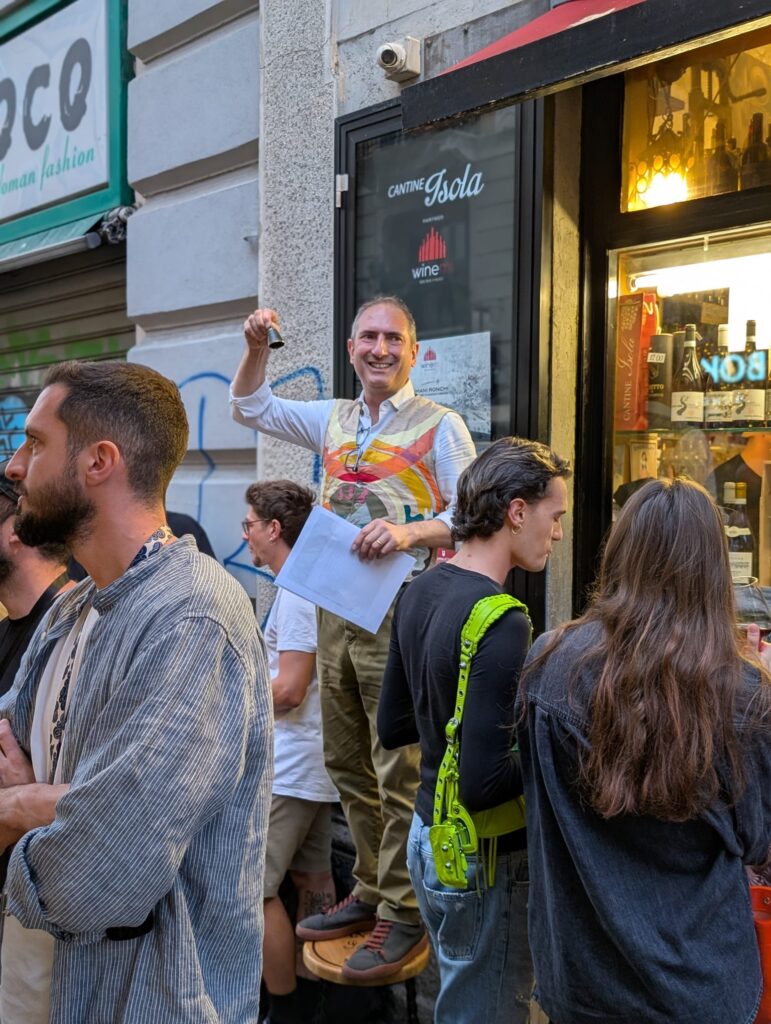
We have also been one of the few businesses that have not received a takeover offer from the Chinese community. It is likely that the presence of a ‘historic shop’ is a guarantee to foster a dialogue between the old and the new, giving the area a patina of global significance capable of attracting more and more curious visitors.
Milan Chinatown today is a residential area mainly inhabited by Italians. It is certainly one of the Chinatowns that attracts interest for integration, culture, and commerce.
Despite the lack of formal governance systems, there is strong collaboration. This is probably also due to the cultural similarity of families and attachment to one’s work. The Italian and Chinese communities share conditions that foster common growth, supported by the parish church of Santissima Trinità and the Giusti, where children and young people have been able to grow together without barriers.
Maintenance of shared gardens is carried out by both communities.
Thanks to common agency, Milan’s Chinatowns, unlike some others facing decline, have been described as ‘reborn’ and bustling, surrounded by cultural venues, similar to those in Bangkok. Its closeness to landmarks and lively districts like Porta Garibaldi and Centro Storico enhances its appeal for locals and tourists. Affordable rents, compared to other Milan neighbourhoods, also make it attractive for residents.
We hope to write another page of history together in the near future, as a step towards a better coexistence of humanity on the planet.