AP4 |
dialogues. pearlyn CHONG
TZE YONG NG.
6th generation artisan, Say Tian Hng Buddha Shop. SINGAPORE.
do you live in chinatown?
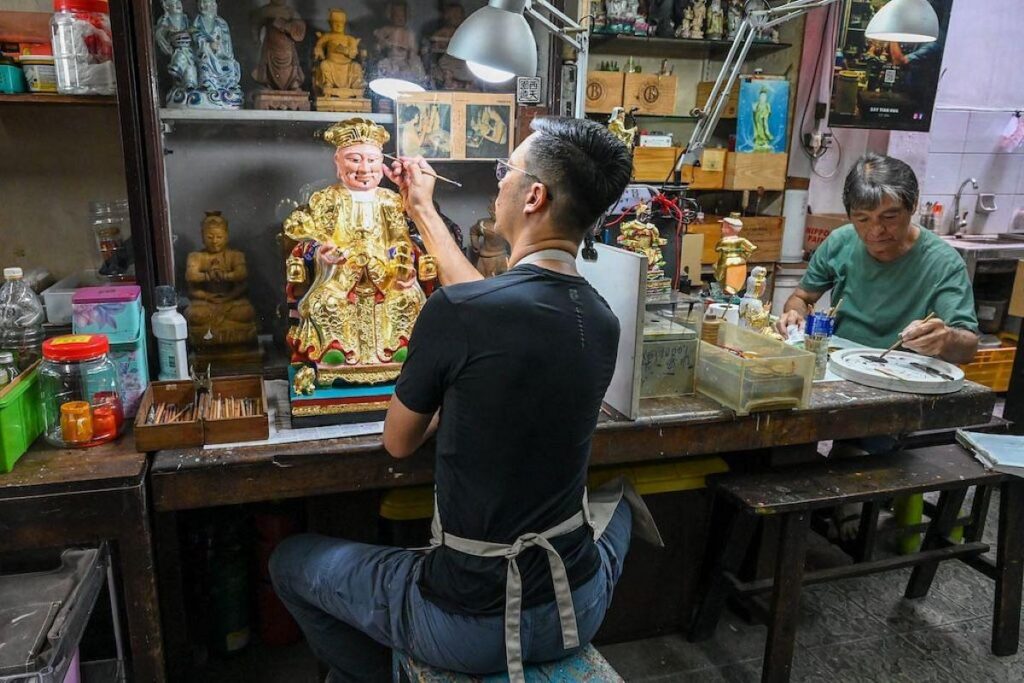
I don’t live in Chinatown but I work there. My family runs a heritage business in Singapore’s Chinatown. We hand-craft wooden statues of Daoist and Buddhist deities and have been doing so since 1840. Today, we’re probably one of the oldest businesses in Singapore.
As a child in the 80s, I remember spending afternoons at our shophouse in Chinatown after morning kindergarten sessions. As my family members worked, I would find things to occupy my time. People watching. Drawing. Playing with stray cats. Waving to tourists.
Today, I’m 45, and I still go to the shop, because I now apprentice under my grandma and dad as the 6th-generation artisan of the family business.
what do you remember of the place from your childhood, how is the world of chinatown different now?
Singapore has a majority-Chinese population, so our Chinatown actually feels similar to much of the country. Generally, Chinatowns are in countries where the Chinese are a minority. There are only 3 countries in the world with a majority Chinese population – China, Taiwan, and Singapore. Of the 3, only Singapore has a Chinatown. So Singapore’s Chinatown is unique – the only Chinatown in a Chinese majority country.
Left to market forces alone, our Chinatown may have faded away, if not for an intentional effort by the government, companies, and charities to sustain and leverage the identity.
in chinatowns around the world, discussions continue regarding ‘disneyfication’ and gentrification, where cultural authenticity is at risk of being overshadowed by commercialisation or marketing efforts. do you feel this is happening here?
In thinking about gentrification, I think often our time horizon tends to be about 30-50 years, about the length of one or two generations. That’s the time span we instinctively adopt, because it connects us, as adults, with things we recall from childhood.
But if we take a longer time span, say, 100 or 200 years, then we see that nothing has ever remained constant. So if nothing remained constant, how do we decide what is authentic? Maybe change is the only way to stay authentic.
I’m not an architect or heritage expert, just someone who grew up in Chinatown. Gentrification feels uneasy to me, as it does to many like me who love culture and history. At the same time, I wonder: If gentrification is happening, it means there is demand, there is supply, there is balance. It’s just what it looks like that makes us feel unease.
But I think gentrification is inevitable, so there is little point in asking whether it is comfortable or uncomfortable, good or bad. Maybe we just need to discover new ways to dance with it.
On our street, new hipster cafes open once in a while. People go, oh, what is happening to the heritage, the soul is disappearing, etc. But that cafe is someone’s dream too, just like our shop was my ancestor’s dream. I hope the new cafe succeeds too, thrives for 100 years, that it will become a heritage business, as some old coffee shops today are. But often, many of them don’t survive. They can’t sustain the rent. Gentrification is brutal to the “gentrifiers” too.
one way to preserve ‘worlds’ is to preserve residents’ lives and occupations. the real stuff.
crafts knowledge transfer is particularly important, and indispensable in this context, transmitting the practical knowledge and history of making.
The tricky thing to navigate would be fairness. Who gets to decide whose livelihoods and occupations are worth preserving? And is it too much to preserve a business whose time has passed? Is it better to close with dignity, than to continue as a pale, false shadow of one’s self?
As a heritage lover, I’m on the side of heritage. But I also realise these are the tough questions I have the luxury to avoid. The policy-makers are the ones stuck with it, and it’s not easy. I think in Singapore, they are doing a great job. Balance is never perfect, and seldom precise, because it is a range. As long as you’re getting criticism from all sides, and you hone the capability to course-correct if needed, that’s the most realistic thing you can do.
your ancestors were among pioneers who came to singapore to open a ‘branch’ of their activities in china, preserving original techniques and know how. how do the implementation of original techniques and product evolution reflect their migration. what kind of adaptation or evolution have occurred in the design and production of item as result of the cultural syncretistic with the local culture? with the being here. are there products born from the ‘singapore’ experience?
Compared to other world religions like Christianity and Islam, Daoism is more decentralised. There is no equivalent of a central authority like a pope, nor a canon like the Koran (The Dao De Jing doesn’t play quite the same role). The religion evolved from the ground up, so there are many variances across geographies and time.
In the past, when Singapore was a developing country, with a less effective government and organized civic society, we received orders for statues of a wider range of deities. People were looking to the gods for more of their basic needs.
For example, given the high maternal and infant mortality rates, an expectant mother might start praying to 注生娘娘, the Goddess of Fertility. Years later, when her child goes to school, she might start praying to 孔夫子, Confucius, the deity who aids academic success. An entrepreneur might worship 关公 (Guan Gong), a real-life general born in 160AD known for his protective prowess and integrity. Many would also have an ancestral tablet listing the names of their deceased grandparents, through which they would honour their memory and submit petitions. Worship involved a range of beings from a supernatural world co-existing with the mortal world through an intimate, powerful relationship. Who you prayed to was a function of life stage, occupation, life circumstances, and fate.
Today, however, this “world” has contracted somewhat, as Singapore became a developed country. Maternal and child healthcare has improved and we’ve now got some of the best hospitals in the world. So that’s one possible reason why we don’t get so many orders for statues of the Goddess of Fertility anymore. We’ve also got some of the best schools in the world, and a $2 billion tuition industry alongside it, so when you got that, maybe you don’t feel the need to rely on Confucius so much.
Instead of the gods with niche functions, it’s now the deities with the more generalised functions, who serve a broader range of needs, who seem to have become more popular. An example would be the Goddess of Mercy, depicted as a compassionate, middle-aged lady, to whom you can look to for many needs (including childbirth), or Tua Peh Kong (Great Elder Uncle), an elderly bureaucrat with an open-ended origin story and powers ranging from protection to wealth creation.
The divine world expanded and contracted, in response to the circumstances in the mortal world.
describe to us some of the ‘inhabitants’ of your world. what is the breakdown of your customers into locals and tourists. what is their profile?
In the past, our customers consisted mainly religious organizations and followers: temples and devotees, in Singapore and Southeast Asia, who commissioned statues for worship, or sent old ones in for restoration. Today, they also include the non-religious: Non-Chinese cultural lovers from Europe, and the US. They commission the statues as works of art and culture. To them, we are mediators, an East-West cultural bridge, as well as a portal to the ancient wisdom and timeless values such as compassion, integrity, courage, etc, that remain just as relevant today.
We also now have locals and tourists who sign up for tours with us. When we started these tours, we envisoned the majority of people who sign up would be tourists. To our surprise, it turned out to be mostly locals. They range from millennials to Baby Boomers, artists to office workers, professors to laymen who know next to nothing about the subject matter, but yet are very curious, very respectful. What draws them is a desire to look deeper into a part of ourselves that we haven’t understood. You see, to many Chinese Singaporeans, Daoism feels familiar, yet strange.
Many of us grew up accompanying our parents to temples and participating in rituals, often without understanding or being taught the meanings behind these practices. As adults, some of us may go on to embrace different faiths or become atheists. Yet, it’s important to recognize that religion and ethnicity are distinct: religion is a choice, while ethnicity is a fact. It’s important to search for ways to hold on to one’s culture regardless of one’s religion.
you are among the youngest operators in the area, having recently (?) decided to take the helm of your family business. what has been your experience so far in doing business in chinatown?
Yes, although I work here only 1 day a week, while juggling a day job for the rest of the week.
On our street, we’ve seen a high turnover of shops. We’d see tenants starting the business , all excited, doing the renovation. Then, after a couple of years, they’d close, and a new tenant comes along. The cycle repeats.
It’s the law of the jungle, and it’s brutal. We are spared because decades ago, my grandfather decided he’d purchase the shophouse we’re in. It wasn’t easy, but he felt we will need a solid foundation for the business. Today, prices have risen, and from an economic point of view, it may make more sense for us to relocate to, say, a suburban industrial estate, and rent our Chinatown shop out. But the shop is more than a shop. It’s a man-cave for my dad, where he spends most of his hours when he’s not at home, including on weekends. For my grandma, it’s a place near her home where she can continue to go to work every day in her wheelchair at the age of 94. Their lives and worlds have been built around this shop. How does one put a value on that?
you have adopted multiple business models and open the laboratory for workshops and visits. do you find that this approach to business has been useful to you ? do you share the results of these ‘innovations’ with other operators in the area.
When thinking of how to innovate a business, one can sometimes fall into the tendency to think of oneself as the centre of the universe, often subconsciously. We constantly remind ourselves that we are just a speck in the universe, that we matter little, and no one owes us a living, that what seems obvious to us may actually turn out to be our blindspot. This mindset helps us stay better in sync with the environment and community. To keep in sync, to calibrate, we continually experiment with small business initiatives.: some fail, most will be mediocre, and only a minority will become clear successes. But the constancy of this motion is what matters.
We do share these innovations on an ad-hoc basis through a talk titled “My Grandma’s Startup” that we have given at museums, art galleries, cultural festivals, and a bank. It allows us to contribute back to the community with our story, learnings, and mistakes. Hopefully it plants some seeds.
we are interested in the collaboration between cultural institutions, territorial management bodies, and communities, particularly their interactions with businesses. how do you engage with government agencies – i.e. heritage board – and other stakeholders as clans organizations, chinatown business association, business committees etc.? do you held regular meetings where you discuss an agenda or similar? are there aspects of governance of the area you discuss together or your offer ideas about?
We collaborate selectively and opportunistically. As a small business, when we engage with larger entities, there is a small risk that we distract ourselves from our priorities, or chase the same goal in at the speed of larger entities. But collaborating with stakeholders is necessary, so it’s about striking a balance. You need to develop an instinct about who to collaborate with, when, and on what. Collaboration is a vague word that can mean anything and everything. It’s tempting to say yes and explore, but sometimes you find yourself stuck once the commitment builds up, and you can’t get out without causing inconvenience to others. Ultimately, there are only 24 hours in a day and a limited amount of energy. While community building may be a priority for a government agency or civic organization, it’s a secondary concern for us because we are primarily a for-profit organization. If we don’t make profits, we don’t survive. Heritage businesses are, first and foremost, businesses.
what aspects of intangible culture from your life and business experience would you like to share with people who are not familiar with chinatown?
It can be challenging to look beyond the surface of Chinatowns because they tend to be very in your face. Sensory overload. Hyperactivity. Loud voices. Lots to see, eat, and buy. But it’s interesting to think about the fact that there are many Chinatowns around the world, in every corner of the globe. The Chinese are cosmopolitan. I’m not talking about Chinese nationality, but about the Chinese race, which includes ethnic Chinese of all nationalities. We’ve had to migrate for various reasons, not all of which were voluntary. But wherever we go, it seems we simply get down to business, making a living. We sell shoes. Handbags. Waist pouches. Shampoo. Run restaurants. Nothing fancy, but effective. We pay the bills, build a family, and keep moving forward. No fuss. And Chinatowns are the physical expressions of this – in their practicality, messiness, and no-nonsense character.