CEDRIC BABOUCHE
game author and art director DORDOGNE. game creator PYLA. PESSAC-SUR-DORDOGNE.
designing against the industry.
most commercial games rely on progression loops (xp, unlocks, levels). dordogne replaces that with a perception loop. from a product design perspective, what is your primary engagement metric—time on task, emotional recall, or replaying through photo albums? how do you measure success during development?
We weren’t really trying to follow any established formula. Our main engagement metric wasn’t mechanical progression, but the player’s voluntary attention. During playtests, we mostly looked at whether players naturally took their time: stopping to observe, listen, and explore without being forced to; taking photos spontaneously; interacting with secondary objects; or simply getting absorbed by the atmosphere. When players slowed their own pace without the game explicitly asking them to, we knew the sensory loop was working.
So success wasn’t only about completion rates or session length, but also about the quality of the player’s presence inside the game world and the emotional connection they built with it.
We were also trying to explore something very universal through personal memories, whether positive or negative. We all have family memories, childhood moments, intimate sensations tied to places or people. Even if the details are different from one culture to another, those emotions are shared by almost everyone. That gave us a way to speak to an international audience through emotion and lived memories rather than traditional reward systems or gameplay progression.
removing failure states is a deliberate retention strategy for audiences fatigued by high-friction games. what was the business hypothesis behind this decision? did you observe lower drop-off rates in the first 30 minutes compared to industry benchmarks? do you have any internal data on session length or completion rates that support this design?
We removed failure states because we wanted to protect the emotional state we wanted the player to be in. Stress, punishment, or repetition would have broken the intimacy and contemplative rhythm of the experience.
One of the main reasons behind this decision was also that we genuinely wanted players to reach the end of the game and experience the full story in all its complexity. More mechanically demanding games can sometimes create frustration or a feeling of rejection that pushes players to stop playing before the emotional payoff happens. From the beginning, our goal was that any type of player should be able to, and want to, finish the game.
Our hypothesis was that if players felt safe and emotionally available, they would become more attentive to small details, memories, and sensations. We wanted them to stay present rather than perform.
We didn’t initially approach the project through aggressive KPI targets or direct benchmark comparisons. Dordogne was quite experimental for us. But during playtests, we noticed that players rarely rushed through the environment. Many stayed longer than expected in scenes, interacted with optional objects, or spent time taking photos without being prompted to do so.
We also saw that players who normally don’t play narrative games stayed engaged because the game wasn’t constantly asking them to prove themselves through mechanics. That accessibility progressively became one of the core strengths of the experience.
traditional reward schedules (variable ratio, like loot boxes) drive engagement through dopamine. your camera system rewards subjective framing, not objective collection. how do you prevent player disengagement? is there an underlying anticipation architecture (e.g. rare lighting conditions, hidden angles) that mimics the unpredictability of a gacha without monetization?
There has never been an interest in recreating addictive reward systems through the camera. The idea was almost the opposite. We wanted photography to feel personal and contemplative rather than optimized.
What kept players engaged was mostly curiosity, emotional projection, and environmental storytelling. We paid a lot of attention to atmosphere, lighting, sound and pacing so that players would naturally want to look around and capture moments that resonated with them emotionally.
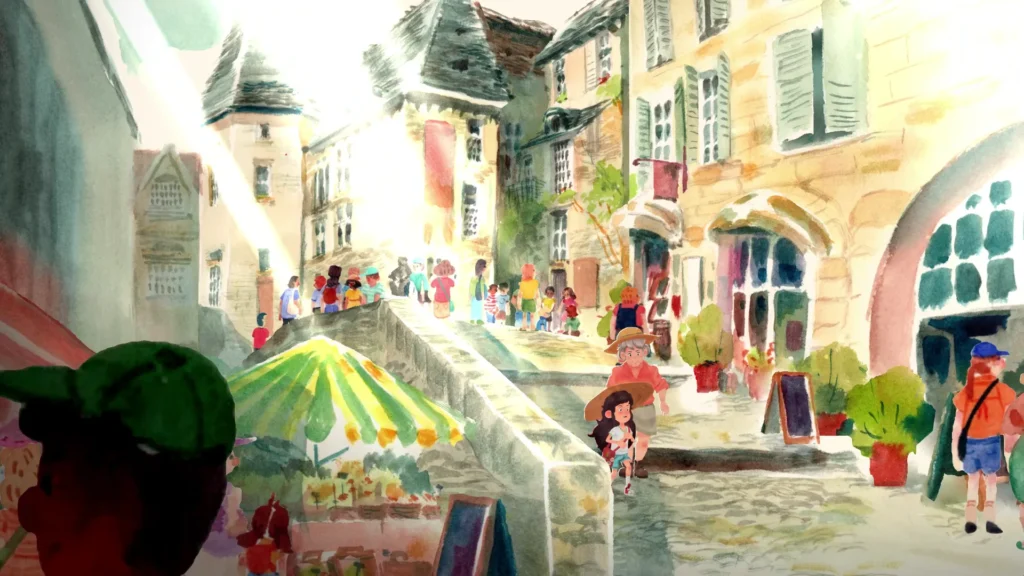
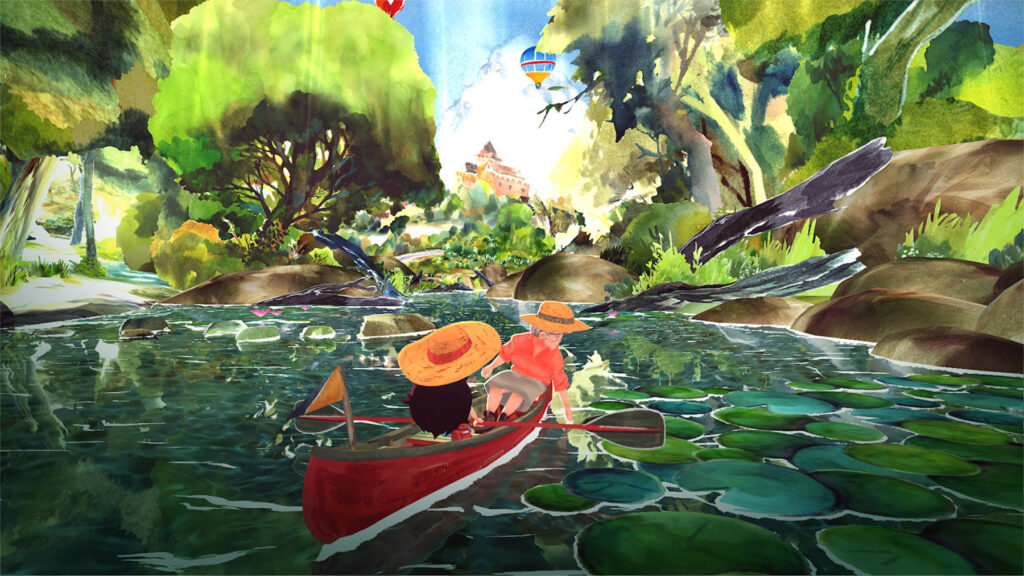
There are definitely subtle forms of anticipation in the game, but they are sensory rather than systemic. A change in light, a sound in the distance, a hidden object, a memory trigger, or an unexpected visual composition can create curiosity and invite the player to slow down and observe more carefully.
We weren’t trying to reproduce the unpredictability of a gacha system, but we were interested in creating moments of quiet discovery. The reward was feeling something personal, rather than “getting something rare,”
what specific operational mechanic in dordogne creates a defensible moat? for instance, the watercolor rendering is aesthetically pleasing, but does it also reduce production costs compared with photorealistic assets? or does the untranslated french increase word-of-mouth and niche community engagement?
The moat comes from a single mechanic in isolation. It comes more from the coherence between the artistic direction, the production methods, and the emotional intentions behind the game.
The watercolor rendering, for example, was never designed as a cost-cutting solution. Quite the opposite. Watercolor is probably one of the most difficult traditional mediums to truly master because so much of its beauty comes from unpredictability, accidents, and spontaneity. We could have used more conventional texturing techniques and safer production methods, but we would have lost a big part of the project’s singularity and emotional texture.
In many ways, this process went directly against controlled and cost-effective production logic. It sometimes created misunderstandings inside the team as well, because not everyone understood why we weren’t choosing safer or more standardized artistic directions. But generally, what is truly unique takes time to produce. That is also why Dordogne is recognized today. It is difficult to compare it directly to other projects because of those choices.
What became difficult to replicate was the combination of handcrafted textures, watercolor workflows, camera mapping techniques, sound design, pacing and environmental storytelling all working toward the same emotional goal.
We also recognized a genuine audience desire for traditional art forms and for something that feels handmade, almost “boutique,” in contrast with highly industrialized visual production. Players could feel the human presence behind the image.
The use of untranslated French also contributed to the game’s identity. Rather than flattening the experience for international audiences, we embraced a form of cultural intimacy. Surprisingly, that often increased immersion and curiosity instead of creating distance. Players projected their own memories and emotions onto details they didn’t fully understand intellectually.
More than a feature, I think the real moat is the sincerity and specificity of the experience. Dordogne is deeply rooted in personal memories, and that kind of emotional authenticity is much harder to industrialize or imitate than a visual style alone.
in user testing, where do players stall? we’re not asking emotionally, but operationally: which interaction has the highest hesitation time or mis-click rate? how did you re-engineer that moment—for example, by adjusting the canoe paddle’s hitbox size or changing the audio cue for a discoverable object—to reduce cognitive load without breaking immersion?
One recurring issue during playtests was that players sometimes hesitated when the game expected a very specific interaction while the rest of the experience encouraged free observation and slow exploration. Because Dordogne is intentionally calm and non-punitive, even small moments of friction become very noticeable.
A lot of our work was therefore about reducing cognitive load without making the game feel overly guided or “gamey.” We constantly adjusted interaction zones, timings, camera framing and audio cues to make interactions feel more intuitive and organic.
Sound design played a very important role in that process. Often, instead of adding explicit UI indicators, we preferred using subtle ambient sounds or spatial audio cues to attract the player’s attention naturally.
We also learned that in a contemplative game, players interpret ambiguity differently. In a traditional game, confusion can sometimes create challenges. In Dordogne, confusion immediately breaks emotional presence. So we became very attentive to rhythm, readability, and interaction flow.
In many ways, the challenge was not about making interactions difficult, but about making them feel invisible enough that players could stay emotionally connected to the moment.
you deliberately left some french phrases untranslated. that’s a localization risk (potential negative reviews from non-french speakers). what was the business case? did a/b testing show that this “foreignness” increased average playtime among english-speaking users, perhaps through curiosity-driven re-reading or community-driven translation sharing?
The use of the French language came first from a desire for authenticity.
Dordogne is deeply rooted in a very specific place, language, and culture. Completely removing that French presence would have made the experience feel less intimate and less truthful. Sometimes emotions are carried not only by meaning, but by the musicality of a language, by a word, or by the feeling that something belongs to a real lived culture.
We were actually surprised to see that many international players reacted very positively to this “foreignness.” Rather than creating distance, it often created curiosity and emotional projection. French naturally carries a certain poetic or romantic imagery abroad, and for some players, even trying to pronounce or understand certain words became part of the experience itself.
That was also true with the title Dordogne itself. Many players initially didn’t know how to pronounce it, but that unfamiliarity made the game more memorable and sparked conversations online.
More generally, we think audiences today are increasingly sensitive to works that preserve a strong local identity instead of trying to become culturally neutral. People recognize when something feels handmade, rooted somewhere real, and emotionally sincere.
your end-of-chapter scrapbook is not skippable. that is a forced pause—unusual in game design. do you track whether players spend more time annotating photos than playing the preceding level? does that annotation behavior correlate with a higher likelihood of recommending the game (nps)? in other words, is the scrapbook a stickiness engine?
The scrapbook was conceived as an important emotional pause in the rhythm of the game, rather than a “stickiness engine” in a traditional retention sense.
Most games constantly push the player forward. We wanted, at certain moments, to do the opposite: to stop, breathe, look back, and let the player reorganize their own memories of what they had just experienced.
The scrapbook transforms gameplay moments into personal memories. The player is no longer simply progressing through the story, but actively rebuilding and curating their own emotional version of it through photos, words, stickers, and compositions.
There was also a very concrete game design reason behind this non-skippable structure. In order to close a chapter and complete the scrapbook, players needed to have collected enough words during the level to create the final haiku. During playtests, we realized that some players were not collecting enough words naturally, which could potentially create a blocking situation at the end of the chapter.
To solve this, we introduced these quieter moments between Mimi and her grandmother. Their conversations naturally encouraged players to collect additional words before moving forward to the scrapbook and poem creation. That pause therefore became both an emotional breathing space and a way to gently secure the progression flow without breaking immersion or adding frustration.
Without this structure, some players could simply reach the end of a chapter without having enough material to complete the poem, which created a problematic dead-end from a game design perspective.
We didn’t specifically track this through NPS correlations or advanced behavioral analytics, but during playtests we noticed that many players spent far more time than expected inside the scrapbook. Some became extremely careful and personal in the way they organized their pages. At some point, it almost stopped feeling like a traditional game system and became closer to journaling or memory keeping.
More generally, we were interested in the idea that emotional engagement can also come from reflection and reconstruction, not only from action and stimulation.
dordogne stands out in a media landscape dominated by fast pacing and constant stimulation. How did you think about player attention and onboarding when designing a slower, more contemplative experience? Did the contrast between the cozy watercolor aesthetic and the heavier emotional themes play into that?
The broader question of player attention in today’s media environment was still very relevant to us. We were aware that players are increasingly used to fast onboarding, constant stimulation, and highly consumable content.
At the same time, we deliberately chose not to build Dordogne around aggressive engagement hooks or hyper-stimulating pacing. The project was conceived as a slower and more contemplative experience.
Interestingly, we also built part of the game’s visibility around a form of contrast. Visually, many players expected a colorful, comforting, and almost entirely “cozy” experience because of the watercolor aesthetic and the marketing imagery. But the first twenty minutes are actually emotionally heavy, darker, and more uncomfortable than people initially anticipate. That contrast created surprise and generated a lot of discussion around the game.
In a media landscape where many experiences become immediately predictable, we were interested in creating something slightly against the current. The visual softness was real, but it was also carrying themes of grief, memory, family tension, and emotional fragility. That tension between appearance and emotional reality became an important part of the game’s identity.
Rather than trying to compete directly with “infinite scroll” culture, we focused on creating immediate emotional and visual singularity. The watercolor visuals, the sound design and the intimacy of Mimi’s memories were all meant to quickly communicate that the experience would feel different from more traditional games.
During playtests, we still paid close attention to the first moments of the game—not necessarily to shorten them, but to make interactions intuitive and onboarding feel natural. We wanted players to enter the experience smoothly, without heavy tutorials or excessive UI friction.
In a way, Dordogne was almost designed as a counterpoint to fragmented digital consumption. We believed there was also an audience looking for slower, more emotionally grounded experiences.
in your next project, can you replicate the dordogne engagement model across a larger production?
I think the challenge is not simply scaling production, but scaling emotional and artistic coherence without losing what makes the experience feel human.
Dordogne was extremely handcrafted. Almost every aspect of the game—the watercolor textures, the pacing, the sound design, the framing, and the environmental storytelling—relied on deliberate artistic decisions rather than procedural generation or systemic content production. That is probably both the strength and the bottleneck of this type of experience.
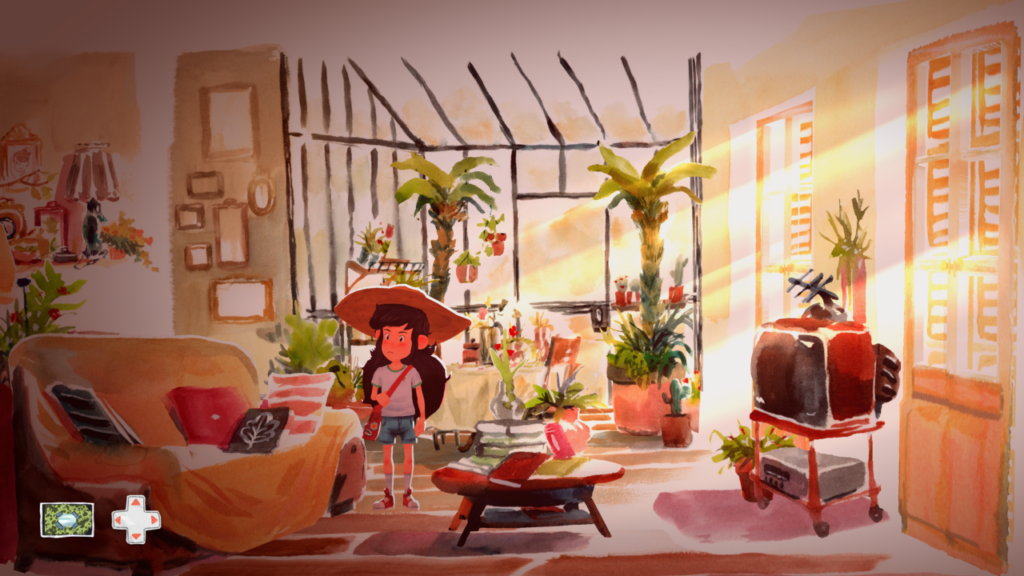
The watercolor pipeline itself is particularly demanding. Watercolor is one of the hardest traditional mediums to truly control because its beauty often comes from accidents, transparency, instability, and spontaneous reactions between pigments and water. Translating that into a real-time 3D environment requires a large amount of experimentation and iteration.
For Pyla, we are already trying to evolve that pipeline without losing the handmade quality that defines the work. The goal is not to industrialize the art direction into something generic, but to build better tools that preserve the original artistic intent while giving more flexibility to production teams.
That is why we are developing a more hybrid approach, mixing hand-painted textures, camera mapping, more traditional 3D workflows, MeshBlend systems, and potentially custom NPR tools directly inside Unreal Engine 5. The objective is to preserve the emotional and pictorial coherence of the world while making larger and more explorable environments possible.
At the same time, one of Pyla’s goals is also to reach a broader audience than Dordogne, especially more traditional gamers and larger international markets, particularly in Asia. The hybrid visual identity between
French artistic sensibility and Japanese influences is part of that reflection. We wanted to take those broader audience considerations into account without losing our soul or what makes our work feel personal.
We also listened carefully to some of the criticisms addressed to Dordogne. Pyla is not about repeating the exact same experience. We still want to remain different, but also challenge ourselves in new directions.
Making a darker, more mature, and more physically tense game after Dordogne is actually part of that intention. In some ways, it may even be unexpected from us. We are not necessarily trying to make the game people expect us to make after Dordogne.
The absence of procedural generation also remains intentional. In Dordogne, and even more in Pyla, meaning often comes from specificity. A place, a light, a silence, a framing, or a small object can carry emotional weight because it was intentionally composed. Procedural systems are powerful for scalability, but they can also dilute emotional precision if they are not carefully controlled.
So yes, handcrafted production is slower and more expensive in some ways. But we also think audiences increasingly recognize and value experiences that feel authored, personal, and genuinely handmade.
In the long term, I believe the challenge is not reducing the human part of the process, but building pipelines and tools that allow artists to preserve that human presence at a larger scale.
for studios building narrative-driven, low-friction games, what is one operational rule you would give them that directly impacts player retention or monetization (if applicable)? for example: “never let the player press a button more than twice to return to a previous memory” or “always pair an ambient sound with a 200ms delay before the next interaction prompt.”
One rule we learned during Dordogne was: never interrupt an emotional state for the sake of a system.
In low-friction narrative games, players are often much more sensitive to rhythm breaks than in more traditional gameplay-driven experiences. A confusing interaction, an unnecessary UI prompt, a badly timed mechanic, or even a slightly frustrating action can instantly pull the player out of the emotional space the game is trying to create.
So a lot of our operational decisions came from asking ourselves a very simple question: “Does this interaction deepen presence, or does it remind the player they are using a system?”
Sometimes the best retention strategy is not stimulation, reward loops or constant interaction density. Sometimes it is protecting immersion long enough for the player to build a personal emotional connection with the experience.
We also learned that players naturally stay engaged when they feel emotionally safe and curious rather than mechanically pressured. In Dordogne, many moments work because the game allows silence, observation and small personal discoveries to exist without immediately transforming them into objectives or rewards.
Interestingly, we also learned this lesson through some of our own compromises. At certain moments, and sometimes against our initial instincts, we added more UI and explicit guidance in order to address a broader audience. In some cases, we later realized that this actually slowed down the experience and weakened the more sensory and intuitive relationship players had with the world.
It taught us that readability is important, but over-explaining can sometimes reduce emotional engagement instead of improving it. For future projects, we want to be even more careful about preserving intuitive and sensory gameplay whenever possible.
More generally, I think low-friction games should avoid treating attention like something to capture aggressively. Attention is something fragile that needs to be respected and carefully guided.
can you share one surprising player behavior that changed how you thought about engagement? for example, did players spend significantly longer than expected in the grandmother’s attic? did that prompt you to add more interactables post-launch?
This was actually one of the most interesting parts of developing Dordogne. We expected players to emotionally connect with certain key narrative moments, but what surprised us most was how long many players stayed in spaces that had no strong gameplay purpose at all.
Some players would simply stop and observe light, sounds, small environmental details, or landscapes far longer than we anticipated. Others spent a huge amount of time taking photos of moments we had not specifically framed as “important.” Sometimes they were more interested in tiny personal details than in the main objective itself.
That changed the way we thought about engagement. We realized that in a contemplative game, engagement is not always driven by action or progression. Sometimes players engage precisely because they feel allowed to exist inside the space without pressure.
We also noticed that players often projected their own memories onto the environment. Certain places triggered discussions about their own grandparents, childhood homes, vacations, or family rituals, even when those memories had nothing directly to do with the written narrative of the game. That was very important for us because it confirmed that Dordogne was functioning less like a traditional story delivery system and more like an emotional projection space.
Another surprising point was photography. We initially saw the camera mostly as a poetic gameplay tool, but many players treated it almost like a personal diary. Some took very composed artistic shots, while others photographed seemingly insignificant details simply because they emotionally resonated with them.