engaging to belong, or engaging to extract. you have worked at the figure of Stamford raffles — a prominent figure in the colonisation of southeast asia — as an extractor of empire, a man who took meaning, resources, and people from places he passed through. as a foreigner in Indonesia, how do you think about the difference between engaging with a place or community to belong to it, and engaging with a place or community to take from it?
As a foreigner in Indonesia, I try to not take the hospitality of my host for granted.
Parable: Raffles’ colleague Farquhar was able to go native in Singapore, married a Nonya and took to wearing sarongs. Farquhar was committed to Singapore, he took the blame for allowing gambling and prostitution to thrive in Singapore out of survivalism with the natives. Farquhar in my view, even as he worked for the same company as Raffles, had engaged to belong, even as his company benefited from Singapore as a port.
like many of us, in a way, as somebody working between singapore and yogyakarta, you occupy a position that could be seen as extractive — taking from one place to make work that sells in another. what type of engagement with the artisans, and in your relationship to the place itself — practices, or commitments — allows your work to be an act of belonging rather than extracting?
An artwork remains a useless object if we think from another standpoint. The promise of remuneration is as puzzling to me as to my artisans. The artisans recognise that the work only gains in monetary value after it leaves the studio for another place labelled Exhibition. This helps us focus on the production, and the will within the process of collaboration.
When I involved the artisans at the exhibition in Singapore by having them there, a sense of pride in them took place, and for a moment my artisans felt a sense of belonging to the Exhibition and not just in the production. This happened in the rare occasion of the Raffles exhibition at the Singapore Bicentennial.
Now that I have gone back to making work alone, the artisans feel aimless in the mundane maintenance and upkeeping of the studio. Lately they expressed frustration that my art is not selling, as they would like me to buy a car for us. Our measure of success differs.
Has extraction switched persons? I try to explain to them why I am consciously making artworks which do not sell, and I also share with them the cost of a recent cancellation of an exhibition in Singapore. They responded by requesting I not pay them their wages.
how much can engagement really impact a place?
If Art engagement is a life force, engagement enlivens a place at its minimal.
could you describe where you are working from at the moment — between Yogyakarta and Singapore — and the work you are most engaged with right now?
In Yogyakarta, I have returned to making drawing, while moving to Yabbiekayu EcoLiving in Tembe, where i have agreed to be artist-in-residence for a year. In Singapore I am catching up with a small circle of old friends, mostly over meals. The only engagement I am making at the moment is with children and volunteers at the new Tak Takut Kids’ Club in Lengkok Bahru.
what is the Tak Takut Kids’ Club and what kind of engagement is possible with children that you do not encounter in your work with adult artisans?
The Tak Takut Kids Club is started over the Pandemic in two underprivileged neighbourhoods as children’s hangouts. Its voluntary and kids centric. Tak Takut means “to not be afraid”, and I have enjoyed hanging out with the fearless children, whose trust have to be earned by grown-up participants. Children sees through adult agenda easily, there is no room for social pretence, we engage easily. That sense of daring through creative play is lost in adults.
when you think about your experience, how would you define social engagement?
I have to learn how to socially engage. And in my experience it is about accepting whoever is willing to engage with you, and opening up yourself to others in shared social space.
small-group practice as a model. you have worked upon a collaborative model. for example, the seamstresses’ raffles series has been made with artisans in yogyakarta. could you describe what working with a small group feels like — what kind of engagement, negotiation, and type of work one can experience in a similar situation that would not happen if working alone?
I have done community projects where engagement with the community is the art itself. The Raffles series, however, was not such a project, but a social enterprise where I paid my Javanese assistants and female artisans to make effigies of Raffles in fabric.
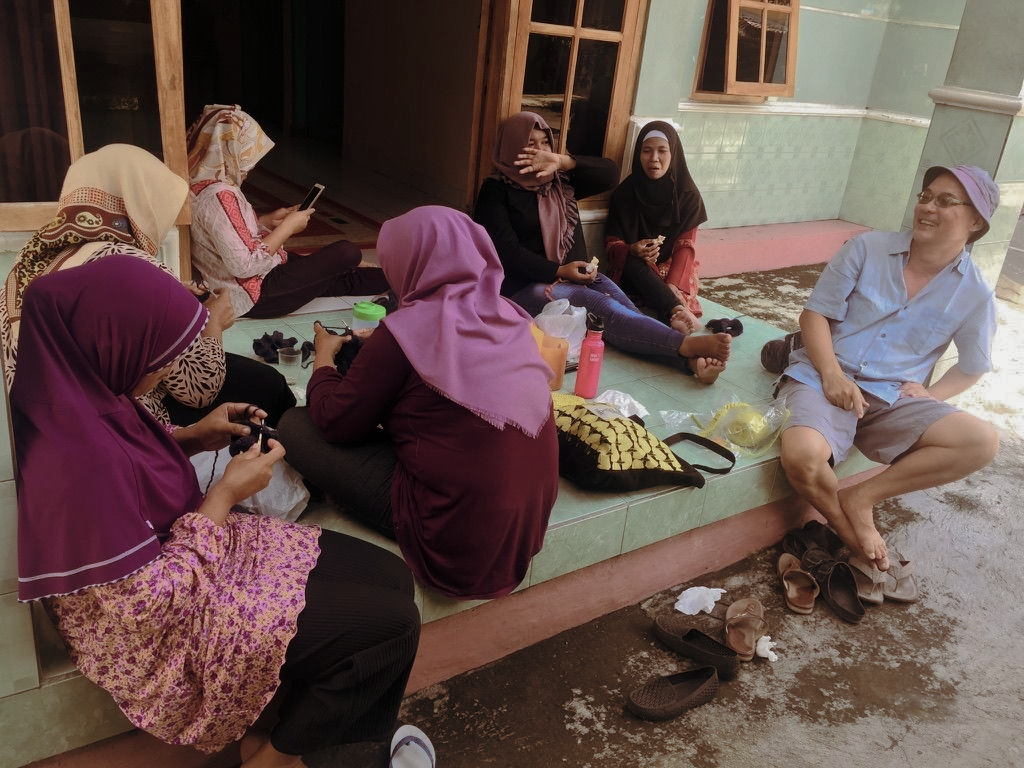
As a foreigner with a pointed idea about Art, I had to initially work at fitting into their tight-knit community, already so familiar with each other. The language, cultural differences together with my western schooling played a part in how they and I adapted to each other. They taught me to sew while I showed them drawings of my vision of these works. My formal introduction of the male anatomy created raucous laughter and giggles. Amidst the chatter, we sang and shared meals. And together developed unconventional ways of sewing to create sculptural forms.
The making of these works would have taken me much longer, with a lot less fun, if I had worked in isolation.
you have used small-group practice to address very large historical subjects such as colonialism. how is making art about a subject different from making art engaging the people the subject concerns?
Making works about Raffles was to have my foot into colonialism as a Singaporean in Java.
An earlier production of my Raffles theme was abandoned when it was apparent to me that it was simply paying for the piece to be fabricated cheaply in Java. I had to shift my approach to avoid just outsourcing my production.
I then looked into reviving indigenous skill like sewing, and in exposing my assistants as artists by sharing my content and crediting them wherever possible.
One assistant took the research and started a guided history tour on his own. Later, a local group used the same theme of Raffles to get a grant for an arts festival. Perhaps having Javanese taking ownership of their own history is evidence of an engagement of sorts.
engagement and habitat. you have been living extensively abroad — singapore, us, indonesia. how did you become socially engaged in the place you have chosen as a person inhabiting a place? what did you have to learn, and what did you have to unlearn?
I did not choose where I wanted to live, but with whom. My spouse and I had a socially deficient experience in our last home in the US, and that ended in divorce, which took me to Indonesia. Singapore is a place of nostalgia to return to, and it has turned out as just a marketplace for exhibiting and selling. Yogyakarta basically opens me up as an artist; the ecology of making and sharing has always been there. I have to learn about the sharing of common resources and kampongs mobilising themselves in natural crisis and disasters.
I need to unlearn individualism; the male ego of the westernised Artist. I am embracing communal living and learn to trust my femininity.
is there a difference between belonging that is inherited and belonging that is made? Is one more real than the other?
In youth, we resist belonging. I have in my youth self-exiled from the place and people I inherited. Art practice becomes a convenient tool and portal to enter into other culture. Like shopping, we move in and out of places and communities.
They are all as real as you want them to be. So in fact, we realise we do not belong anywhere.
looking at your personal experience as well as you’re working one, is social engagement something that scales up gracefully, or does something get lost when it does?
Engagement either ends or transforms. But if one remains in connection there is no loss except with time. In the right conditions, past engagement may bud and grow in other forms perhaps.
in your view, what is the smallest group in which real engagement can happen, and what is the largest?
I like to say two at its smallest, and a village at its largest. A village because when it is scaled up it either corrupts or diminishes.
after thirty years of practice — living, engaging with friends, family, and working in collaborations with artisans, with museums, with critics, with viewers — across three countries, what is the assumption about social engagement that your experience has most challenged?
An artist is not a social worker. Sometimes an engagement brings to surface an issue or need of a focus group. It is very hard and often beyond the artist’s capacity to try to change the lives of people they have engaged with. It led to disillusion on the part of the focus group, and the artist is seen as unhelpful, if not a troublemaker.
Is engagement possible when remote?
Engagement is like a manifestation of life energies. As social beings, we cannot stop engaging, even as we recoil or retreat. And we are constantly engaging with non-humans, the snow, the flowers, sunshine. And yes, it is possible to remotely engage: the way your ancestors left you traces of themselves, your DNA, your memory; to cause you to respond in bodily reflexes.
how has your experience informed the meaning of a word like engagement, now loosely used by museum directors, by brands, by community organisers, by platforms? when you hear it, what do you wish people meant by it?
Immersive experience is now a commodity. Artifice and sensorial rooms are created to entertain, not engage socially. Artists as magicians are masterly in creating such engaging object, platform, spaces. Engagement however, cannot be one sided. What matters is that it springs from you and is wrought from human relations.
when you speak of immersive experience as commodity and of artists as magicians of engaging objects and spaces, are there examples that prompt this observation? What do you see when contemporary art moves from engagement to entertainment, and what is lost in that transition?
The iLights night festival, it does not engage you socially. When an institution mobilise art to include a wide demographic and over-inclusive agenda, the artworks become entertainment. Perhaps you can consider it as another form of remote* engagement: one directional, like a public announcement to a consumer-audience. An opportunity to learn something of one another as humans is lost.