MATTEO BITTANTI
media theorist. curator. writer. artist . associate professor of media studies, IULM University. MILAN.
just what is it that makes video games so different, so appealing?
Every cultural form has a logic.[1] Film organizes time through editing. Music organizes sound through rhythm and harmony. Literature organizes meaning through language. Videogames organize response. A game registers what a player does through rules, feedback, constraints, and iteration. Participatory theater, ergodic literature, interactive installation, and live role-playing had already unsettled any simple boundary between action and reception. Since the 1980s, videogames have given that reciprocity a computational form, making bidirectional response – a sui generis conversation – the defining grammar of interactive mass culture.
Across social media and digital platforms, “engagement” names the commercial management of attention and behavior: cultivating loyalty, increasing return frequency, extending session length, and converting habit into revenue. In digital games, however, it is sometimes used to refer to the feedback loop between player action and system response. Most novels and films present a fixed sequence: readers and viewers supply interpretation, memory, feeling, and judgment, but the work does not update itself in response. A digital game does. It receives input and returns altered conditions. Its systems accept, refuse, redirect, or transform action. Responsiveness gives game engagement its distinctive form. For Ian Bogost, games make arguments procedurally: they persuade through the rule systems a player must inhabit and act within.[2] Jesper Juul’s description of games as “half-real” gives that process its ontological frame, since the player confronts real rules inside a fictional world.[3] Engagement begins where these rules become operative for the player, where action is registered, answered, constrained, and returned as consequence. Mihály Csíkszentmihályi’s concept of flow helps explain why this relation can absorb attention so completely. Flow can arise in rock climbing, surgery, musical improvisation, and carpentry, wherever skill and challenge meet in productive tension.[4] Digital games add a technical condition to that psychological state: they answer action in real time, without delay, adjust difficulty through output, turn failure into information, and make player decision the variable around which experience is organized. The philosopher C. Thi Nguyen argues that games are artworks in the medium of agency.[5] Designers arrange abilities, constraints, goals, and practical environments. Players inhabit those temporary conditions through action. Gordon Calleja describes this involvement as bodily as well as interpretive: play reorganizes timing, attention, perception, and acquired motor habit.[1] Game engagement is incorporated, that is, it depends on felt consequence, on the player recognizing that the system has answered.
The responsiveness of videogames takes distinct forms across genres and design traditions. The four examples that follow give the argument its comparative range. In Tetris, it appears as immediate feedback. In Dark Souls, it becomes a discipline of repeated failure and acquired skill. Papers, Please translates administrative procedure into ethical charge, while Minecraft makes player action visible as a persistent alteration of the fictional world.
tetris: puzzling engagement.
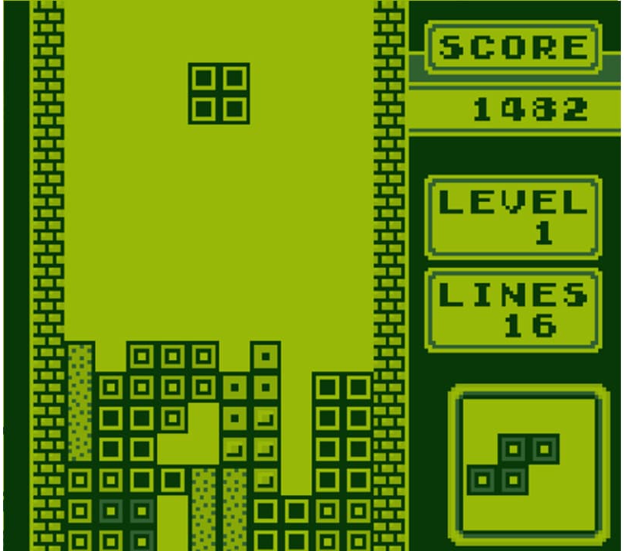
1. Gameplay screen from the Game Boy version of Tetris (Nintendo, 1989), showing a falling tetromino above an accumulated field of blocks, with score, level, completed lines, and next-piece preview displayed on the right. Screenshot supplied by the author.
Tetris (designed by Alexey Pajitnov, 1984–1985) shows this logic in concentrated form. This legendary puzzle game is built from falling tetrominoes: seven geometric pieces, each composed of four square blocks. These pieces descend into a rectangular field, and the player must rotate and position them to complete horizontal lines, which then disappear and create new space (Fig. 1). The premise is simple, but each placement changes the conditions of the next move. A misplaced piece remains in the field, narrowing the player’s options as the speed increases. Juul’s account of games as real rules joined to fictional worlds helps explain the power of a form so spare. Tetris offers almost no character, setting, or story. Its drama comes from the rule system itself, which gives error a durable shape. Engagement forms as a tight circuit between perception and consequence: the player sees, acts, and immediately inherits the result.
dark souls: failure can be fun.
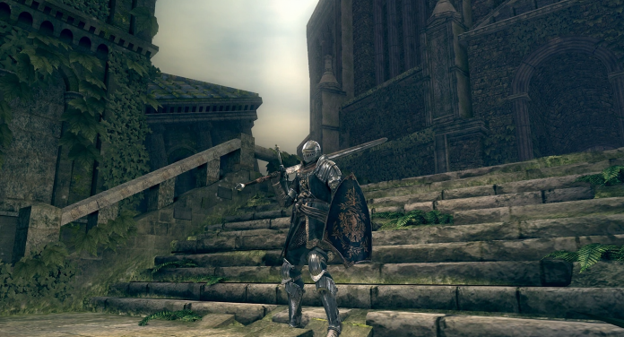
2. Dark Souls (FromSoftware; Namco Bandai Games, 2011). Gameplay screenshot showing the armored player character, equipped with sword and shield, standing on stone steps before a ruined dark-fantasy structure. Screenshot supplied by the author.
Dark Souls (FromSoftware, 2011) turns response into endurance (Fig. 2). In this action role-playing game set in a decaying dark-fantasy world, players explore hostile environments, fights recurring enemies and bosses, and gathers “souls,” a resource used for leveling, purchasing items, and improving equipment. Bonfires operate as checkpoints: they allow the player to rest, restore health, and return after death, but they also reset most defeated enemies. Death sends the player back to the last bonfire and places unspent souls at the site of failure. If the player reaches that point before dying again, the souls can be recovered. If not, they are lost.
By the standards of entertainment design built around access, ease, and uninterrupted progress, Dark Souls operates like a failure machine. Players die repeatedly, return to the same spaces, and learn through consequence rather than explanation. The game provides no difficulty setting and no option to purchase an easier path. Its tutorial logic is distributed across sparse messages, enemy placement, environmental traps, and repeated defeat. Its commercial success helped popularize the Soulslike, a genre subsequently named after the series, and unsettled an industry that had spent years smoothing the path to player success.
Mastery in Dark Souls depends on resistance. The system does not bend toward the player. It trains attention through timing, spacing, risk, and repetition. Every death teaches enemy behavior, impatience, greed, or overconfidence. Every cleared obstacle registers as achievement because competence has been acquired rather than granted. The message system extends this logic socially, allowing players to leave warnings, jokes, traps, and encouragement for strangers. No designer scripts the individual exchanges. A designed affordance makes shared difficulty visible. Frustration can become pleasurable when failure is legible as information and recovery feels earned.
papers, please: ethically charged interactivity.
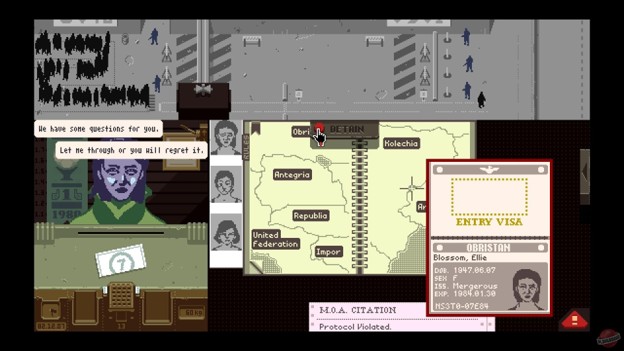
3. Papers, Please (Lucas Pope; 3909 LLC, 2013). Gameplay screen showing the player’s inspection booth, an entrant’s visa document, the rulebook, detention command, citation notice, and queue outside the border checkpoint of the fictional state of Arstotzka. Screenshot supplied by the author.
Papers, Please (Lucas Pope, 2013) turns response into an ethical dilemma. The player works as an immigration inspector for the fictional nation of Arstotzka. Rules multiply across the workday. Each entrant presents documents, stories, discrepancies, and risks. A mistake can reduce the family’s income. Compassion toward one entrant may expose others to danger. Rigid procedure may separate a couple or condemn a vulnerable person to refusal.
Kafka’s The Trial and Costa-Gavras’s Z show how literature and cinema can represent bureaucratic violence with extraordinary force: one through the opacity of legal procedure, the other through the machinery of political repression and official cover-up.[1] Papers, Please assigns the operation to the player. Approval stamps, denial stamps, violation notices, searches, and end-of-day accounting make ethics procedural. The game gives the player a desk, a rulebook, a queue of bodies, and a wage system that converts moral discomfort into administrative action. Miguel Sicart’s account of the player as ethical agent helps clarify why the moral burden belongs to the player’s performance within rules rather than to a message delivered from outside the system.[2]
minecraft: engagement as worldbuilding.

4. Minecraft (Mojang, 2011). Gameplay screenshot showing a block-based landscape with pink-leaved trees.
Minecraft (Mojang, 2011) is a sandbox game built around the placement, removal, and recombination of blocks. It gives players a manipulable world without a scripted narrative, fixed route, or required victory condition. The player alters the environment, and in a saved world those alterations can persist: a house, tunnel, farm, server monument, ruined experiment, or unfinished machine remains as a material trace of play. Katie Salen Tekinbaş and Eric Zimmerman’s concept of meaningful play helps explain the value of this persistence. Meaningful play occurs when the relation between player action and system outcome is discernible and integrated into the larger game context.[1]Minecraft exemplifies that relation: the world changes shape because the player acted, and the changed world becomes the condition for later action. The open-ended,player-led worldbuilding model has had extraordinary commercial reach: by April 2025, Minecraft had sold more than 350 million units worldwide, according to Guinness World Records.
engagement beyond gamification.
Across these works, meaningful response takes different forms: perception in Tetris, discipline in Dark Souls, moral accounting in Papers, Please, and authorship in Minecraft. Substantive game engagement identifies this relation: a dynamic, iterative system changes state because of the player’s choices, and those consequences remain legible enough to be learned and carried forward.
Engagement, in this sense, describes a relation rather than an incentive layer. Gamification borrows selected motifs from games, including points, badges, leaderboards, quests, and reward loops, then redeploys them as behavioral prompts. What disappears is the reciprocal structure that gives play its distinctive nature: action answered by consequence inside a rule-bound world. Jane McGonigal’s solutionist model, in which game design is framed as a transferable resource for improving work, education, health, and civic life, treats games as motivational, functional technologies before accounting for the specificity of play as a responsive experience.[1] In fact, gamification is the antithesis of play.[2]
Extractive engagement follows the same reduction inside the game industry itself. From FarmVille’s timed crops, neighbor obligations, and return incentives to Fortnite’s seasonal battle passes, limited-time rewards, and purchase-driven cosmetics, the system measures continued presence as value. The player is trained to remain available. Publishers can measure return visits, session length, spending propensity, and conversion rate with great precision. These figures describe traffic, monetization, and habit. They say little about play. A metric cannot tell whether a choice has changed the conditions of a world, whether failure has become knowledge, whether an ethical decision has left discomfort behind, or whether a player has built something that will still be there tomorrow.
Substantive engagement leaves traces that exceed the dashboard: a skill acquired through repetition, a ruined structure in a saved world, a decision the player would rather not have made. Extractive engagement captures habit, delays departure, and turns attention into revenue for someone else. The difference is visible in what remains after the session ends. In one case, the player leaves a trace inside a fictional yet responsive world. In the other, the game system extracts a pattern from the player and carries it beyond play.
NOTES.
[This formulation is indebted to the tradition of symbolic-form theory associated with Ernst Cassirer and Erwin Panofsky, especially Panofsky’s account of perspective as a historically specific organization of space and perception. See Erwin Panofsky, Perspective as Symbolic Form, trans. Christopher S. Wood (New York: Zone Books, 1991); Ernst Cassirer, The Philosophy of Symbolic Forms, 3 vols. (New Haven: Yale University Press, 1953–57).
2 Ian Bogost, Persuasive Games: The Expressive Power of Videogames (Cambridge, MA: MIT Press, 2007), 2–3, 28–29.
3 Jesper Juul,Half-Real: Video Games between Real Rules and Fictional Worlds (Cambridge, MA: MIT Press, 2005), 1–7.
4 Mihály Csíkszentmihályi, Flow: The Psychology of Optimal Experience (New York: Harper & Row, 1990), 71–93, 108–11, 154–56. [1] C. Thi Nguyen, Games: Agency as Art (New York: Oxford University Press, 2020), 1–24.
5 C. Thi Nguyen, Games: Agency as Art (New York: Oxford University Press, 2020), 1–24.
6 Gordon Calleja, In-Game: From Immersion to Incorporation (Cambridge, MA: MIT Press, 2011), 35–54, 167–80.
7 Franz Kafka, The Trial, trans. Breon Mitchell (New York: Schocken Books, 1998); Costa-Gavras, dir., Z (France/Algeria: Valoria Films/Reggane Films/ONCIC, 1969).
8 Miguel Sicart, The Ethics of Computer Games (Cambridge, MA: MIT Press, 2009).
9 Katie Salen Tekinbaş and Eric Zimmerman, Rules of Play: Game Design Fundamentals (Cambridge, MA: MIT Press, 2003), 34.
10 Jane McGonigal, Reality Is Broken: Why Games Make Us Better and How They Can Change the World (New York: Penguin Press, 2011).
11 C. Thi Nguyen, The Score: How to Stop Playing Somebody Else’s Game (New York: Penguin Press, 2026).
BIBLIOGRAPHY.
Aarseth, Espen J. Cybertext: Perspectives on Ergodic Literature. Baltimore: Johns Hopkins University Press, 1997.
Bogost, Ian. Persuasive Games: The Expressive Power of Videogames. Cambridge, MA: MIT Press, 2007.
Calleja, Gordon. In-Game: From Immersion to Incorporation. Cambridge, MA: MIT Press, 2011.
Costa-Gavras, dir. Z (France/Algeria: Valoria Films/Reggane Films/ONCIC, 1969)
Csíkszentmihályi, Mihály. Flow: The Psychology of Optimal Experience. New York: Harper & Row, 1990.
Epic Games. Fortnite Battle Royale. Multiplatform. Cary, NC: Epic Games, 2017.
FromSoftware. Dark Souls. Tokyo: Namco Bandai Games, 2011.
Guinness World Records. “Best-Selling Videogame.” Accessed May 21, 2026. https://www.guinnessworldrecords.com/world-records/best-selling-video-game.
Juul, Jesper. Half-Real: Video Games between Real Rules and Fictional Worlds. Cambridge, MA: MIT Press, 2005.
———. The Art of Failure: An Essay on the Pain of Playing Video Games. Cambridge, MA: MIT Press, 2013.
Kafka, Franz. The Trial. Translated by Breon Mitchell. New York: Schocken Books, 1998.
McGonigal, Jane. Reality Is Broken: Why Games Make Us Better and How They Can Change the World. New York: Penguin Press, 2011.
Mojang. Minecraft. Stockholm: Mojang, 2011.
Nguyen, C. Thi. Games: Agency as Art. New York: Oxford University Press, 2020.
———. The Score: How to Stop Playing Somebody Else’s Game. New York: Penguin Press, 2026.
Pope, Lucas. Papers, Please. 3909 LLC, 2013.
Salen Tekinbaş, Katie, and Eric Zimmerman. Rules of Play: Game Design Fundamentals. Cambridge, MA: MIT Press, 2003.
Sicart, Miguel. The Ethics of Computer Games. Cambridge, MA: MIT Press, 2009.
Tetris. Designed by Alexey Pajitnov. Moscow: Dorodnitsyn Computing Centre, Academy of Sciences of the USSR, 1984.
Zynga. FarmVille. Facebook/Adobe Flash. San Francisco: Zynga, 2009.