how would you describe your business proposition? how would you describe the business of your hostel?
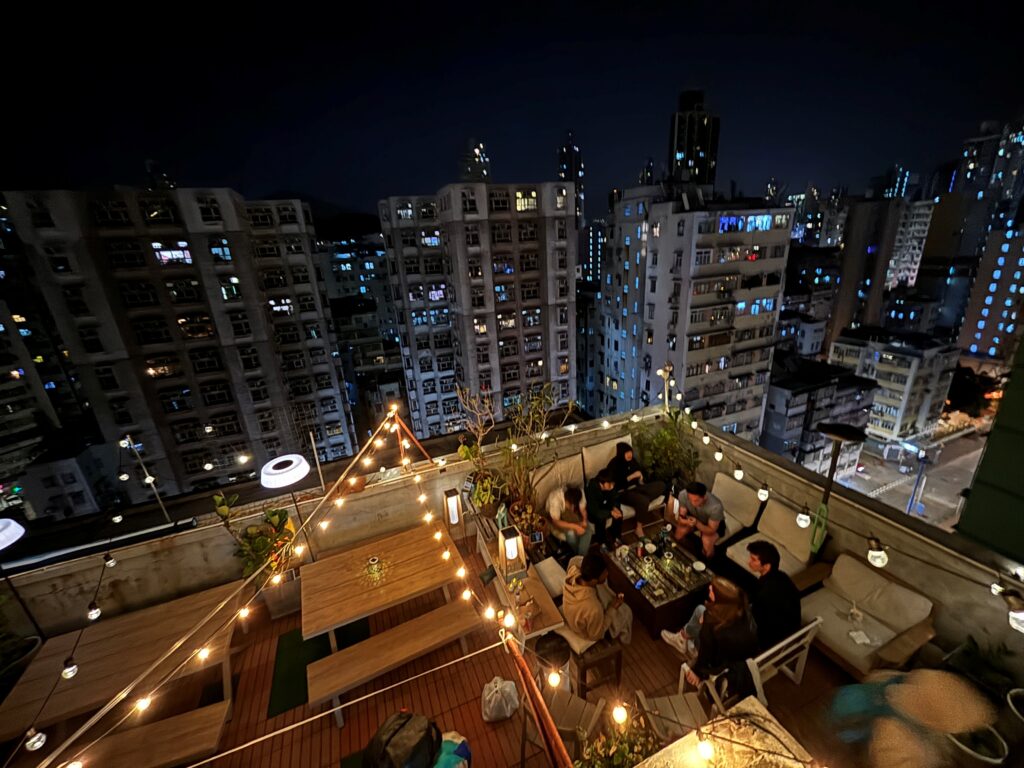
Wontonmeen is a design-led, multi-functional hospitality platform that provides authentic cultural experiences. In a market dominated by standardized and sterile small hotels, our business proposition is built on “Local Asset Activation”. We have converted physical real estate into a dynamic oasis where common spaces, such as an unexpectedly open rooftop, restore and connect communities.
what does “engagement” mean to you personally when running a hostel in a city as fast and dense as hong kong?
Engagement is the time when we can virtually or physically build memories together. As Hong Kong is physically very dense, which makes it easier to meet people, being in the center of Kowloon serves as a catalyst for any kind of engagement.
engagement is often reduced to metrics: length of stay, social media tags, repeat visits. but you seem to value quieter, unmeasured forms of connection. what data (if any) do you actually find useful in understanding whether a guest truly engaged with the hostel, rather than just passing through?
Travelers’ reviews are usually quite meaningful than just a generic, AI formulated ones. Personal dialogues also help me understand their experiences.
how has your understanding of what guests truly want from a hostel evolved—especially in a post-pandemic, highly digital world?
I have noticed they value privacy more, even in a dormitory environment, guests are more introverted but still want to be “present” in a social space.
what you do is distinctive in character. what are the specific moments or design choices in the physical space do you believe create the strongest sense of connection and belonging for guests?
Guests usually compliment the little details in the hostel. I suppose I always put myself through those experiences of connection.
could you paint a picture of the creative community that has formed around wontonmeen? who are they—artists, curators, musicians, locals? and how do they actively participate in and contribute to the guest offering? what does their presence bring that a traditional hostel cannot replicate?
Again, the unexpected encounters, whether it’s the rooftop or the communal events, make the connections meaningful.
Today, everything can be booked and reviewed online. what do you feel are the irreplaceable elements of in-person, tactile encounters that still matter most in hospitality? what simply cannot be replicated through screens?
I don’t think it’s that binary; it is more like a collaborative or integrated experience. We all live with our phones now, as they provide not only entertainment but also means of survival in many different ways. But whether it’s online or in person, the authenticity of human connection cannot be replaced, and I guess that’s what makes it special here. We are still interacting directly with guests, digitally or physically, so they can feel our humanity, our spontaneity, our way of communicating, which could be uniquely cultural. Sometimes, it’s even our flaws and the ways we amend them that make the connection authentic.
how do you approach the digital side of guest engagement—from booking to social media to reviews? where do you intentionally draw the line so that technology supports rather than replaces human connection?
As we have an extremely small team, we only reply to the negative comments, using AI to polish any personal or emotional remarks.
today, guest data can be used to create highly detailed profiles, how do you navigate that line personally? do you ever worry that too much data analysis or pre-booking profiling might strip away the spontaneity of meeting someone fresh at the front desk?
Yes, as I am quite a religious person. I truly believe that God brings my customers to this place.
in the context of hong kong’s intense environment, how do you create a sense of emotional safety, belonging, or renewal for travelers?
We have designed dormitory beds that are not packed like sardines; most beds have their pocket of space, ensuring that sense of privacy, safety, or renewal. The communal rooftop gives that extra sense of relaxation, whereas most rooftops in Hong Kong have been underutilized for whatever reasons.
have you observed any ways guests form deeper connections—either with staff, other travelers, or even with the city—because of something that happened at the hostel?
Yes, we have remained friends with many of them. Sometimes our staff would reconnect with the guests in their home countries, where the roles of host and guest are shifted.
as someone running a hospitality space in one of asia’s most competitive cities, what are you experimenting with right now to deepen engagement in these times?
I’ve recently developed a strong new passion for mental health. The loneliness economy is growing rapidly worldwide, and travel has become one of the main ways people try to “cure” that loneliness. They’re not just paying for a “bed”—they’re paying for a memory, and that memory is open to each person’s own interpretation.
I’d like to use the hostel to help guests meet others in a more meaningful way—not necessarily in a matchmaking sense, but to build deeper, more authentic relationships. I’ve found that when people are in a cozy, safe space and given gentle prompts (like OH Cards), strangers are often much more willing to open up without the usual preconceptions or prejudices they face from people who already know them. It feels almost like group therapy—a place where people simply need to be heard and genuinely connected.
More hostels are using guest data to personalize experiences—suggesting activities, roommates, or local tips. Where do you draw the ethical or emotional line at wontonmeen between helpful personalization and invasive profiling? How do you ask for consent in a way that doesn’t feel transactional?
As our hostel is still a very small one, we don’t have the resources to invest in that kind of profiling. Maybe in the future I would love to be able to use it, as I think it’s quite a cool idea. At the end of the day, guest can choose whether to give that information at the beginning, right? I think it’s great how technology is bringing like-minded people across the globe closer, but at the same time there will be a lot of simulacra—and I am sure we won’t be one of them.
what lessons have you learned about balancing efficiency and profitability with creating meaningful experiences? where have you drawn the line, and where have you been willing to “over-invest”?
I think my own personal time, as it sometimes takes time to build relationships. Since I also have a 9-year-old neurodivergent son who is quite demanding, I just wish I had more time to spend with the guests.
In what ways has the hostel become a “third place” not just for travelers, but for locals as well?
Hong Kong has always been known as an international city, so besides the usual areas I wish to create a true cultural hub which genuinely feels “international”.
looking ahead, do you see physical hospitality spaces becoming more important or less important as digital tools become more sophisticated?
In reality, both are essential. As more people travel, there will naturally be greater demand for physical hospitality spaces. At the same time, digital tools are already transforming many labor-intensive hospitality services. Ultimately, it’s always the human butler, concierge, manager, curator, or organizer who makes the experience truly stand out. Without these humans, it is just a matter of hardware comparison for consumers, which I believe can also work, as seen in Japanese capsule hotels. In fact, I think more consumers are accustomed to checking in without human interaction, especially after COVID. But it’s that extra human touch—to understand each of your guests, with or without the help of technology—that makes the difference, just like caring for your loved ones over Zoom during COVID times.