CHENG HOO PEH
community and grassroots leader Kreta Ayer-Kim Seng (KAKS). Long Service Medal. BBM. SINGAPORE.
volunteers engagement.
kreta ayer is a densely populated, historically significant district characterized by a mix of elderly residents, heritage businesses, and young professionals. how do you identify and categorize your two primary groups—volunteers and beneficiaries—and what data or mapping tools do you employ to ensure the volunteer program aligns with the neighborhood’s demographic and social needs?
Our approach is largely ground-driven. Many of our long-time volunteers are also residents, and they bring deep, lived understanding of the community’s needs and dynamics. Their insights help us identify emerging issues and shape outreach efforts in a practical and responsive way.
In terms of programs, we often start by piloting initiatives based on observed needs on the ground. We then gather feedback through simple surveys and engagement with participants to refine and better direct future efforts. We also pay close attention to participation trends. Initiatives that receive strong and sustained responses are a good indicator of underlying community needs.
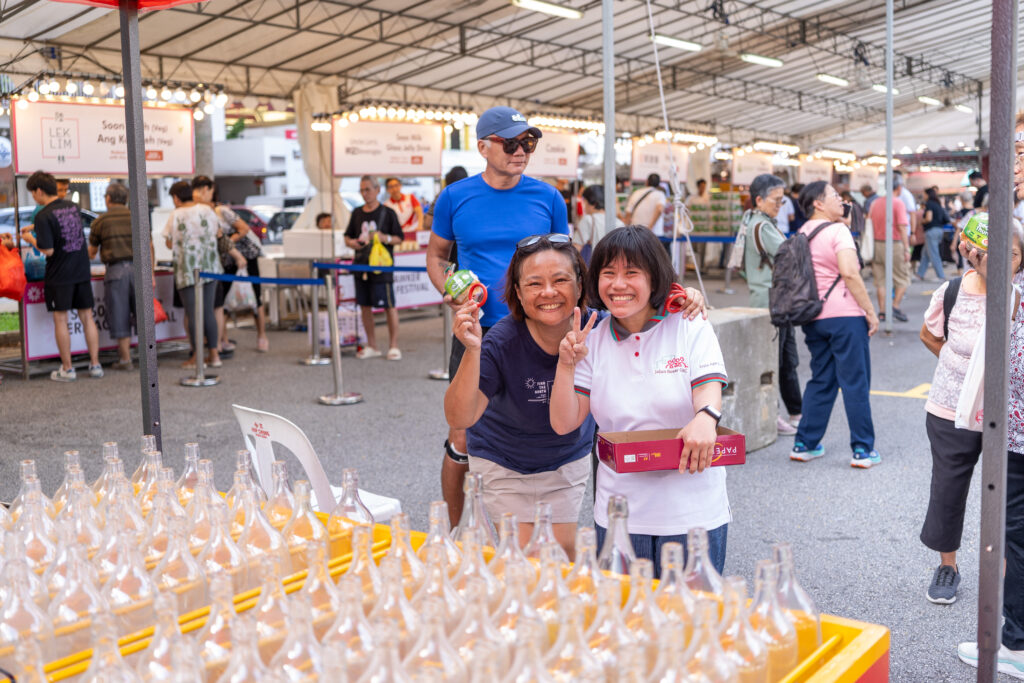
Our main focus areas are elderly care, family befriending, and youth care. Many of our events also incorporate food as a natural connector. For example, during the SG60 Hawker Heritage Festival, we featured 60 different food and beverage offerings to celebrate Singapore’s 60th birthday while showcasing our rich hawker culture. Snacks and meals are a regular part of most activities, allowing residents to fully enjoy the programmes without interruption.
what structured systems do you utilize for recruiting and onboarding volunteers? do you depend on open calls, targeted outreach, referral programs, or collaborations with local organizations? how do you evaluate motivation and commitment during the selection process to ensure a pool capable of providing consistent, high-quality embodied interactions with the public?
We recruit volunteers through a mix of open invitations at community activities, referrals from existing volunteers, and partnerships with local stakeholders who are able to mobilize individuals for specific initiatives.
For onboarding, we provide a simple orientation to help new volunteers understand the purpose of the activity, their roles, and what to expect. Rather than relying on a one-time assessment, we take a progressive approach. New volunteers typically start with smaller, manageable roles, which allows both the team and the individual to assess fit over time.
We observe indicators such as reliability, responsiveness, and willingness to learn. Volunteers who demonstrate consistency and commitment are gradually entrusted with greater responsibilities. This approach helps us build a dependable pool of volunteers who are able to engage meaningfully and consistently with the community.
volunteers need to engage residents in face-to-face. what specific training methods and programs do you use to equip volunteers with the skills for embodied engagement—active listening, reading nonverbal cues, managing group energy, and creating safe spaces for spontaneous serendipity?
Our training approach is intentionally practical and experience-based. We begin with simple guidance—such as how to greet residents, listen attentively without rushing, and engage with empathy, respect, and patience.
Much of the learning takes place on the ground. New volunteers are paired with more experienced ones during visits and activities, where they can observe interactions, pick up cues, and gradually build confidence by participating.
We also incorporate short debriefs after each activity to reflect on what went well and where volunteers may need support. This helps reinforce learning in a timely and relevant way.
Over time, we recognize that volunteers have different strengths. Some are more comfortable with one-to-one engagement, while others do better in group settings or operational roles. We try to match them accordingly, so they can contribute meaningfully while continuing to develop their interpersonal skills.
could you outline the complete operational process for a standard volunteer activity, covering briefing, preparation, on-site execution, and debrief? additionally, how do you design the activities to emphasize physical presence, collaborative effort, and multi-sensory engagement over mere transactional service delivery?
For most volunteer activities, we follow a clear but flexible flow. We start with a planning stage, where the volunteer lead aligns the team on the activity’s purpose, expected participants, roles, and logistics. Input from both experienced and newer volunteers is considered, and plans are adjusted to better suit the needs and profiles of residents.
Preparation is then organized in small functional teams—for example, set-up, activity facilitation, logistics, or participant engagement. On the day itself, we conduct a short briefing to ensure everyone is clear on their roles, flow of the program, and any key safety considerations.
During the activity, team leads provide light coordination and support, ensuring residents are included, interactions remain welcoming, and the overall environment is positive. After the session, we conduct a brief debrief to gather feedback, identify improvements, and note any follow-up actions where needed.
In designing activities, we prioritize shared experiences and interaction. This includes hands-on elements such as simple games, collaborative tasks, storytelling, or neighbourhood-based activities. The intent is to create opportunities for genuine connection through doing things together, rather than a purely transactional or service-based engagement.
how do you systematically engage and retain volunteers over time? what methodologies do you use to sustain high motivation and ensure volunteers continue to provide authentic, warm in-person interactions with residents?
We sustain volunteer engagement by creating a consistent, supportive, and well-communicated environment. Activity schedules and expectations are shared early, and volunteers know who to approach if they need clarification or support.
Recognition is kept simple but regular. We acknowledge contributions through appreciation messages, informal shout-outs, and by sharing brief stories of how residents have benefited. This helps volunteers see the impact of their efforts in a meaningful way.
We also maintain feedback loops through short post-activity check-ins, where volunteers can share their experiences and highlight any challenges. Where needed, we follow up individually to provide support.
For retention and development, we adopt a progressive approach. Volunteers who demonstrate commitment are gradually given opportunities to take on larger roles, such as leading small groups, supporting planning, or mentoring newer volunteers. Peer support is an important part of this system—pairing newer volunteers with more experienced ones allows for ongoing learning and helps build confidence over time.
how is the volunteering initiative governed and structured? what is the decision-making hierarchy, and how are roles clearly defined? how do you maintain accountability while preserving the flexible, human-centered spirit of neighborhood collaboration?
We adopt a simple but functional structure. Organising community events is no small undertaking, particularly as we strive to ensure our programmes are inclusive and accessible to all residents. Every volunteer plays an important role and is entrusted with specific responsibilities.
To support these efforts, each committee operates with a clear organisational structure comprising Chairman, Treasurer, Secretary, Auditors, and Committee Members. This provides proper governance and oversight for every project. Beyond organising events, grassroots volunteers are also involved in developing ground-up initiatives, supporting social welfare projects, and, in the case of the Residents’ Network, addressing municipal issues and community concerns.
Roles are communicated clearly during planning and briefing stages so that everyone understands their responsibilities. At the same time, we preserve flexibility by empowering volunteers to respond to real-time needs on the ground. This balance allows activities to remain responsive and human-centred while maintaining accountability.
what key performance indicators and methodologies do you utilize to evaluate volunteer engagement and the quality of their public interactions? besides metrics like hours logged or beneficiary counts, how do you gauge more profound outcomes such as emotional bonds, a sense of belonging, repeat involvement, and the enduring “human traces” established through physical presence?
We use a combination of quantitative indicators and qualitative observations to assess volunteer engagement and the quality of interactions.
On the quantitative side, we track participation trends—such as volunteer turnout, retention rates, and whether individuals take on increased responsibilities over time. These give us a baseline sense of commitment and continuity.
Beyond that, we place strong emphasis on qualitative signals from the ground. This includes observing whether residents choose to stay longer during activities, return for subsequent sessions, engage more openly in conversations, or build familiarity with specific volunteers. Such behaviors provide insight into the level of trust, comfort, and connection being formed.
We also incorporate brief reflections from team leads after each activity to capture what worked well and where improvements can be made. In addition, general engagement on community communication platforms helps us gauge which initiatives resonate with residents.
While these methods are not exhaustive, they provide a practical and holistic view of both participation and the deeper, more human outcomes we aim to achieve, such as a sense of belonging and sustained community connection.
what funding sources and partnership models support the program, such as government grants, corporate sponsors, and community donations? how do these partnerships influence your engagement strategies, and what operational lessons from kreta ayer could help scale similar volunteer-driven, hands-on community initiatives to other districts or cities?
We are supported through a mix of partnerships and contributions, which may include funding for program materials, in-kind donations, services, or manpower support during activities. These partnerships are selected based on alignment with community needs and values, with a strong emphasis on ensuring that activities remain resident-centred and non-commercial in nature.
Clear planning and coordination with partners allow us to enhance program quality—such as improving accessibility, strengthening logistics, or enriching activity materials—while maintaining the core focus on meaningful interaction between volunteers and residents.
From our experience, several key principles are important for sustaining and scaling such efforts: programs should be anchored in clearly understood resident needs, roles and responsibilities among partners and volunteers must be well-defined, activities should be intentionally designed to encourage shared participation and interaction, and investing in volunteer leadership development is essential so that programs remain sustainable and can grow organically over time.