Mr. Kodama, you uphold a tradition that predates modern branding (1946). In your view, what does true longevity require of those who carry on a craft—not just survival, but staying relevant over time?
The ceramics industry in this region has been passed down continuously since my childhood. In that context, I don’t really have much awareness of continuing the work with the perspective of setting grand goals and saying, “This is how we’re going to do it.”
place is rarely neutral. how does a specific geography become an inseparable part of what we create? beyond the physical elements, how can makers cultivate a living connection to a territory, ensuring that craft not only benefits a community but also actively supports its social fabric, stories, and future?
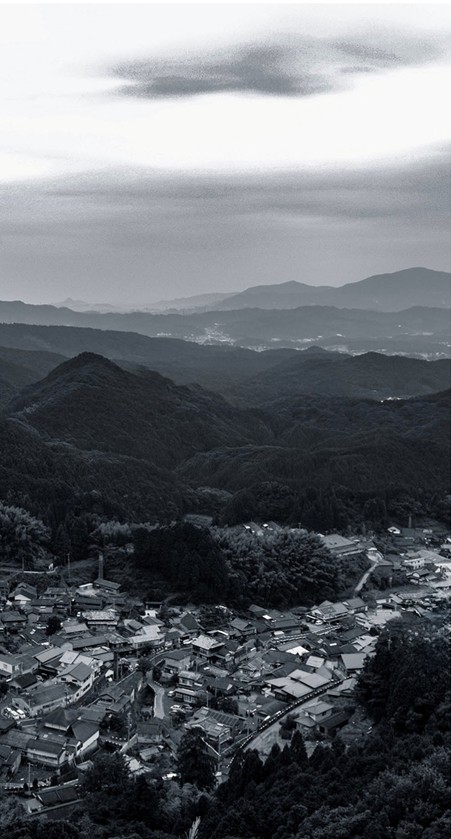
About 400 years ago, the technology for making ceramics was brought to this region from the Korean Peninsula, and ever since, people in this region have been continuously engaged in it.
That’s why it has developed and persisted through the interaction between the local environment and its people. Typically, ceramics are made from clay, but the raw material used here—porcelain stone—is unique to this region.
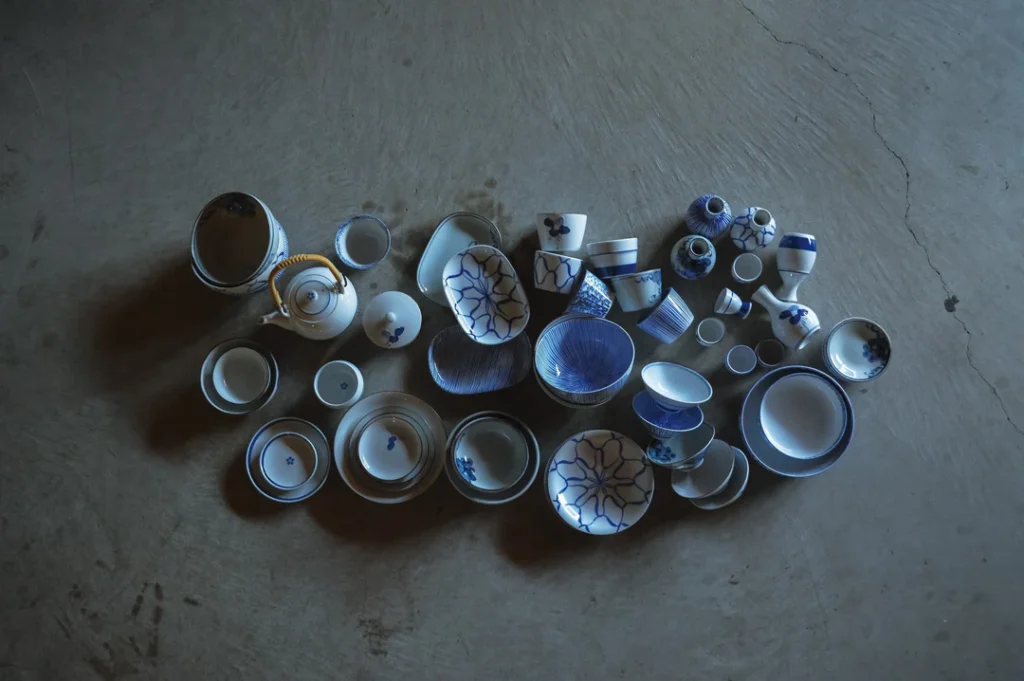
To explain briefly: pottery is made from clay, which forms when organic and inorganic matter settles at the bottom of water, and fine particles gradually compact while remaining moist. Materials like wood debris mix in and harden into clay layers. When you shape this clay and fire it, all the organic material burns away. That’s why pottery is porous and absorbs water. However, the porcelain made in this region does not absorb water. We crush stone into small pieces to create the clay, and since there’s no organic matter in it, water doesn’t pass through. On top of that, the surface is coated with a glassy glaze—a vitreous substance. So we produce ceramics that are impermeable to water.
That’s why areas like Hasami and Arita nearby became centers for porcelain production. When you eat rice, pottery absorbs water, which can cause discoloration and is not very hygienic. Porcelain, however, doesn’t absorb water, so it stays clean and hygienic, and stains wash off easily. This region, where porcelain stone was discovered and the technology was brought over from Korea 400 years ago, became a porcelain-producing area for these fundamental reasons.
Lifestyles naturally differ across eras, so the shapes and sizes of vessels change somewhat to suit the times, but the core production of porcelain has continued unbroken throughout this flow. For example, in Europe, they struggled to achieve this, so they developed things like bone china through various innovations. I’m not sure of the exact timing, but probably around 300 years ago, they discovered new types of pottery and porcelain again.
This tradition has been passed down in the region and continues to the present day.
The connection with local residents is through work. This area’s local industries have always been agriculture and the ceramics industry. For example, people would farm—growing rice or vegetables—during the agricultural seasons and fill their spare time with ceramics work. That’s how people have lived here. Rather than forming companies or anything like that, ceramics has naturally coexisted within the environment and continued in this region. So the connection between people and this industry has inevitably become one and the same—it’s not something that was artificially brought in to create a bond.
in a culture that increasingly measures value by speed, which disciplines still define “well-crafted” for you? where do you personally draw the line between honoring technique and embracing necessary evolution? often, these products are sold through wholesale shops in remote locations, rarely by staff who have been trained in product knowledge. how do you recommend ‘training’ users and consumers about the product?
Speed means change in the world. Changes in society naturally come our way, and for us, that translates into changes in lifestyle.
For example, in Japan, in the past it was normal to have meals around a low table (chabudai) in a tatami room, but now people eat at tables. As a result, the way houses are built and the environment have changed. Because of that, the products we make naturally evolve, but if we don’t adapt to those changes, ceramics won’t survive. The challenge is how quickly we can incorporate those changes. To do that, since the market is now almost entirely in urban areas, we have to study the lifestyles of those people very carefully. Being in a rural area like we are, it’s hard to grasp that directly. So, the most important thing is how well we can connect with people who specialize in that. Over the years, we’ve made a conscious effort to build connections with people involved in lifestyle and design. By having them express it for us, we can create things that fit today’s way of living. So, what I think about most is how to bring in young people who are carrying the era and at the forefront of it—how to incorporate them into the region or build networks with them. That’s the biggest issue, and it’s something we’ve been focusing on as a region and personally for a long time.
The relationship with careful craftsmanship centers on adapting it to contemporary lifestyles. To ensure the region continues to maintain a strong presence as a production area, the most important thing, when thinking about the industry as a whole, is to team up solidly with people who are sensitive to current trends and keep introducing new things to the world.
I think this ongoing appeal to the market is the fundamental thing.
the transmission of knowledge across generations is one of the unique skills in Japan. what have you learned about practical guidance that cannot be conveyed through words alone, and about initiatives to get young people interested in manufacturing/making things?
As times change, there is naturally a generational gap. People in their 20s, 40s, and 60s, for example—broadly speaking, there are many differences—but in every era, new things always come to the forefront of society. From the perspective of those of us running the business, in order to prepare for the next era, we constantly have to incorporate ways of thinking and manufacturing that align with the people of that next generation. To do that, there is a time gap between the artisans and the production floor on one side and the market on the other. So there need to be people who act as interpreters—people who properly convey to those on the production side that “in this era, this is what is needed.”
Making things is our company’s mission, and I don’t understand everything myself. Therefore, we bring in staff capable of doing this—people who share this mindset—as employees or invite them as partners. We create a flow in which they guide the production floor or think through things together with them. I believe that establishing this flow is our company’s mission.
can a family business endure without big changes? what tacit measures have you taken to evolve in time?
This applies to any company, but if you do what the times require, then—whether it grows big or not—work will definitely arise there as long as there is a need. The most important thing is to clearly recognize what kind of work you or your company should be doing and what role you yourself should play—to truly know yourself.
For example, when cameras were needed, a huge number of cameras flooded the market, right? But once mobile phones and other alternatives appeared, people didn’t need standalone cameras as much anymore. It’s the same with books: when books are needed, they are essential, but now that we can read books and get information in various ways online, the market changes. In each era, things don’t disappear completely—books still have their place—but the key first step is to firmly recognize what unchanging core your work has, what makes it your essence.
If you firmly recognize that, you can think clearly about your role. If you start doing something that society no longer needs, it can only fade away.
Doing business while staying connected to the world is the same principle: the major premise is to remain fully aware of why you are there in the first place. If you keep doing that steadily, sometimes things will spread widely, and sometimes they won’t—but there will be times when you don’t make much profit, and that’s just how it is.
To sustain a long-term commitment, I believe it comes down to properly discerning for yourself whether what you are doing is something that was needed in the past, is needed now, and will continue to be needed in the future.
often, these types of products are sold through wholesale shops in remote locations, rarely by staff who have been trained in product knowledge. how do you recommend “training” users and consumers about the products?
Our company does send out messages about our lifestyle, and we can also introduce it through social media , but we need to make proper efforts in that area. Ultimately, we are providing physical products. No matter which country they come from, I think it would be ideal if the products themselves have a certain assertiveness—if, when customers look at them, they can imagine “this can be used in this way,” or if the products can give users some degree of emotional impact. To achieve that, we put serious thought and heart into the manufacturing process. Fundamentally, what we are doing is providing objects that people can enjoy and feel will enrich their lives or give them a sense of “this is nice.” Of course, we also explain the background to some extent. We naturally provide information in various forms, such as “this was made in this way” or “this is what it is.” But at the core, I believe what’s important is that the object itself can express something that people in America, China, or Europe can all understand—an expression where the object itself makes its own statement.
looking ahead, as lifestyles and preferences evolve with each era, what aspects of traditional forms and sizes in ceramics should the next generation preserve, and what new elements should they naturally incorporate for contemporary uses for craft is to remain a timeless yet adaptive form?
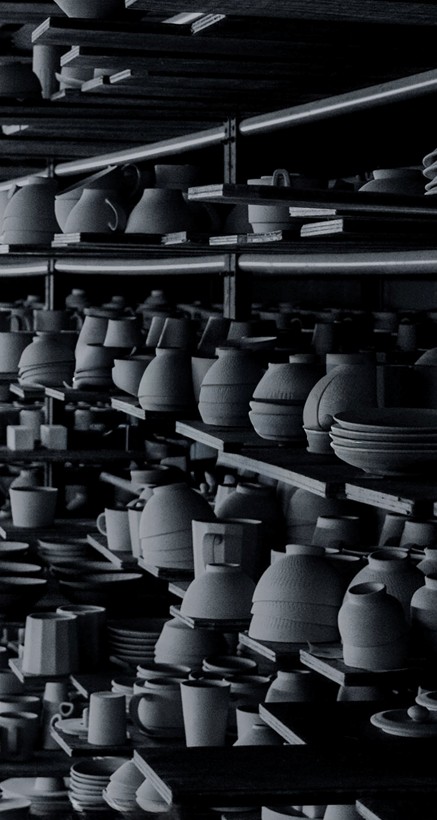
Ceramics have existed since the beginning of humanity, especially items like tableware, which have continued eternally. You can’t eat by grabbing food with your hands, and in the past, things were made of wood or other materials, but ceramics have practical advantages like being hygienic. They possess these fundamental strengths.
On top of that, ceramics have a certain emotional quality—a kind of sentiment. When you touch them by hand, there’s warmth, and they have organic shapes. Customers naturally develop an attachment to them. There’s an element that sets them apart from mere objects.
For example, with electrical appliances, when something new comes out, you can replace the old one with it. If there’s something more convenient, easier to use, and cheaper, people naturally switch to the new one. The things we make—vessels—are consumables in a sense, but they exist within human history and must express human sentiment or emotion. That different element is what defines the world of our ceramics business. There’s also the aspect where a grandchild thinks, “This vessel that Grandma used is nice,” and wants to use it. Or conversely, a daughter buys a modern vessel for her elderly grandmother, and the grandmother is moved, saying, “This is nice.” So these aren’t products that only have value in being new—nor is it that old things are always better. What we have is the feeling that the thoughts of the people who are creating the era in each period are conveyed through them. That’s a kind of value or mindset we hold in our business.
as lifestyles evolve with each era, what traditional aspects of ceramics—such as forms and sizes—should the next generation preserve, and what new elements should they incorporate to keep the craft timeless yet relevant?
People have been using utensils, and ceramics during the history of mankind.
In Japan, for example, the size and volume of rice bowls are more or less fixed, so the size of tea bowls is generally determined. In Europe, you don’t need such large vessels for eating meat or vegetables. Sizes are more or less settled, so those aspects remain.
But relying only on that becomes somewhat out of step with the times—for instance, people might think a bit more depth would be better, or a sharper shape would be nicer. Those changes are incorporated based on the background of each era. We don’t consciously think in terms of “discard this and adopt that.”
However, when people who are thinking about the next era emerge, and the times shift toward preferring something a bit rounder and softer than the shapes we’ve had until now—for example, when you hold a matcha bowl used for drinking tea, it has warmth and a pleasing weight, doesn’t it? Because those qualities remain, people involved in making them, selling them, or handling them in various ways naturally feel, “This fits nicely in the hand.” That sense is instinctively ingrained, so we cherish it. At the same time, though people may no longer drink matcha, all sorts of new beverages are appearing. We naturally think about what would be best for those—whether a slightly larger size is better, a smaller one, something with a better mouthfeel, or something that looks good. We believe we have to incorporate various elements like that in each era